
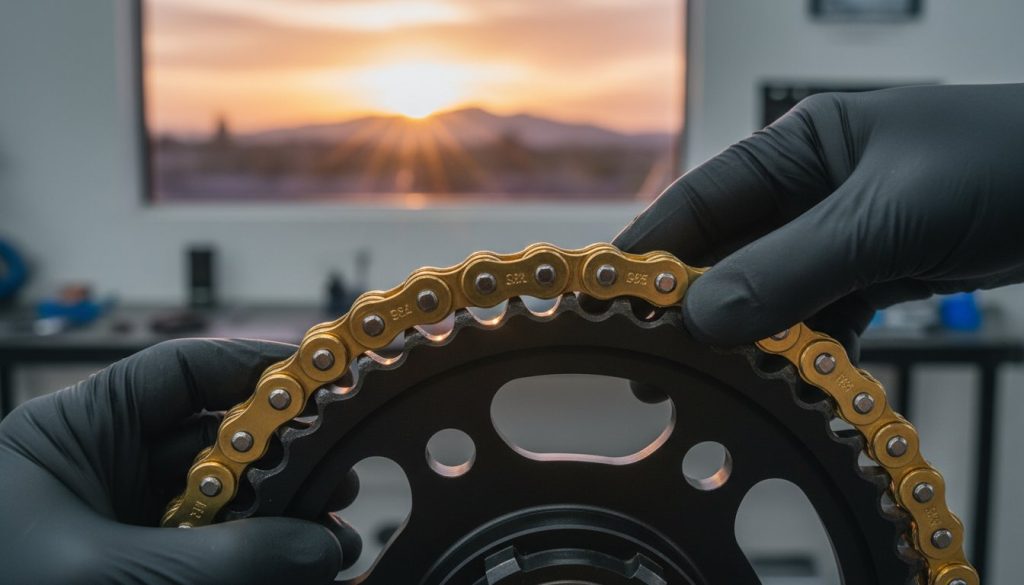
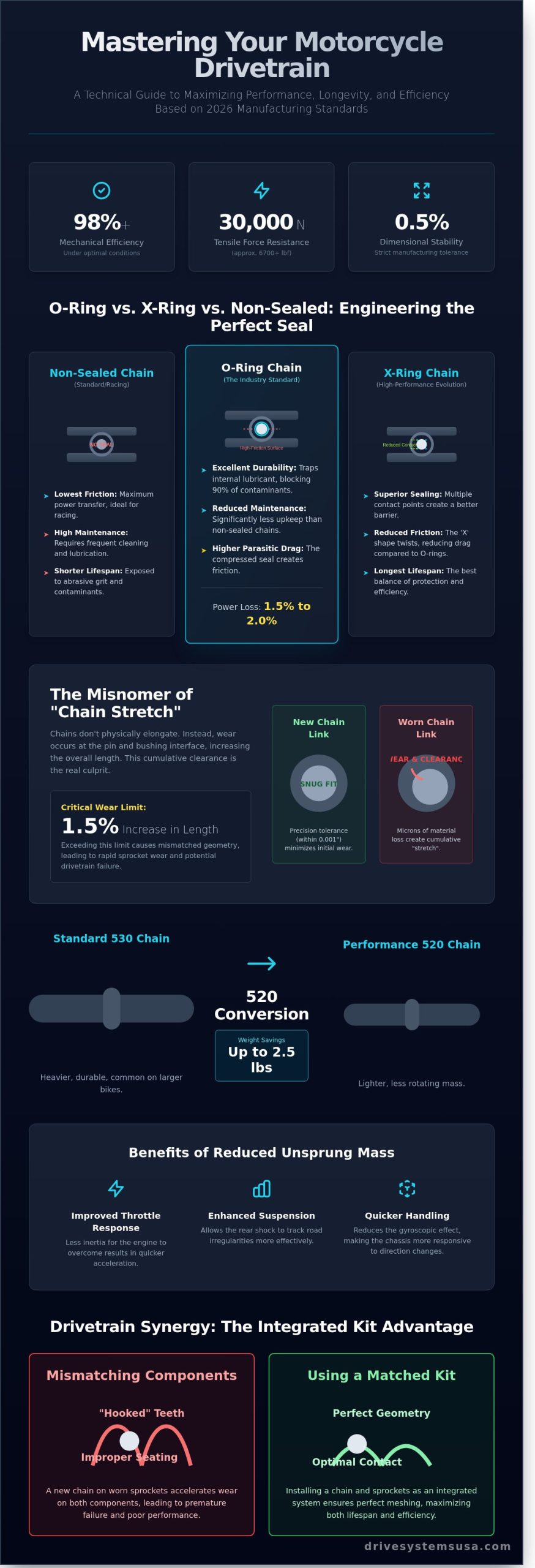
A high-performance 520 motorcycle chain must withstand over 30,000 Newtons of tensile force while maintaining dimensional stability within a strict 0.5% tolerance. You recognize that even the most sophisticated engine cannot overcome the parasitic drag of a poorly matched or neglected drivetrain. It’s frustrating when premature wear or improper pitch selection compromises the precision of your machine’s power delivery. We’ll help you master the technical nuances of seal geometries and pitch sizing to ensure your equipment achieves maximum operational longevity and efficiency. This guide provides a detailed analysis of the engineering behind O-ring and X-ring technologies, the mechanical benefits of 520 versus 525 conversions, and why drivetrain synergy is the definitive factor in performance optimization. By the end of this technical review, you’ll be able to identify the exact specifications required for your application and understand the value of a precision-matched kit for long-term reliability. We’ve compiled these insights based on 2026 manufacturing standards to provide a clear path toward drivetrain excellence.
Key Takeaways
- Analyze the mechanical relationship between tensile strength and fatigue resistance to ensure optimal power transmission under high-torque conditions.
- Compare the performance profiles of O-ring, X-ring, and non-sealed architectures to determine the ideal balance of protection and efficiency.
- Master the technical specifications of pitch and roller width to execute a precise motorcycle chain conversion for enhanced performance.
- Implement rigorous maintenance intervals and diagnostic techniques to identify internal link wear before it compromises drivetrain integrity.
- Understand the engineering advantages of replacing chains and sprockets as an integrated system to prevent premature component failure.
Understanding the Role of the Motorcycle Chain in Power Transmission
The motorcycle chain serves as the critical bridge between the gearbox output shaft and the rear wheel assembly. It’s an engineered system designed to handle extreme torque loads while maintaining a mechanical efficiency rating often exceeding 98 percent under optimal conditions. This component is the most stressed part of the drivetrain because it operates in an open environment, unlike the protected gears within the engine casing. It must survive 10,000+ RPM at the countershaft sprocket while facing constant exposure to abrasive road grit and thermal fluctuations that can reach 150 degrees Fahrenheit during high-speed operation.
Engineers evaluate performance using two distinct metrics: tensile strength and fatigue resistance. Tensile strength indicates the maximum static load a chain can withstand before breaking. Fatigue resistance determines how many millions of cycles the metal can endure before microscopic cracks form from constant oscillation. A motorcycle chain with a 9,000-pound tensile strength is only effective if its fatigue life is equally robust; otherwise, the repeated transition from tension to slack will eventually cause side-plate failure. Drive Systems USA prioritizes this balance to ensure long-term reliability in high-torque applications.
Rotating unsprung mass directly affects a motorcycle’s handling dynamics and acceleration. A heavy drive chain increases the gyroscopic effect, which makes the chassis more resistant to rapid direction changes. Swapping a standard 530 O-ring chain for a lightweight 520 racing variant can reduce rotating mass by up to 2.5 pounds. This reduction improves the suspension’s ability to track road irregularities, as the rear shock has less inertia to manage during high-speed compression cycles. Every gram removed from the drivetrain results in a measurable gain in throttle response and braking efficiency.
The Mechanics of Chain Stretch
The term “stretch” is a common misnomer in the technical community. Chains don’t physically elongate through the thinning of metal; instead, they experience wear at the interface between the pins and bushings. As these components lose microns of material, the cumulative clearance increases the overall length. When a motorcycle chain exceeds a 1.5 percent increase in length, the mismatched geometry prevents rollers from seating correctly in the sprocket teeth. This accelerates wear patterns, often leading to hooked teeth. Precision tolerances during manufacturing, held to within 0.001 inches, are vital for minimizing the initial wear-in that occurs during the first 500 miles of service.
Just as the performance of a drivetrain relies on the precision of its pins and bushings, other mechanical systems depend on similar engineering; for those interested in the complexities of locking mechanisms, you can visit Lockpick Pros to learn more about security pins.
Material Science in Modern Chains
Leading manufacturers like D.I.D and EK utilize high-carbon alloy steels specifically formulated for high-tensile applications. These alloys incorporate chromium and molybdenum to enhance surface toughness and core ductility. Advanced heat treatment processes, such as induction hardening, create a dual-property component that absorbs impact without fracturing. For a high performance 520-pitch racing chain, tensile strength represents the static load threshold, typically exceeding 8,000 pounds, at which the side plates or pins undergo catastrophic structural failure. Modern metallurgical standards ensure these materials maintain their integrity even when subjected to the extreme centrifugal forces generated at speeds over 180 mph.
O-Ring vs. X-Ring vs. Non-O-Ring: Engineering the Perfect Seal
The transition from open-link systems to sealed technology represents the most significant leap in motorcycle chain engineering since the 1971 introduction of the first O-ring design. Before this era, riders relied on the labor-intensive process of boiling chains in paraffin grease to ensure lubricants reached the internal pin and bushing surfaces. Modern sealed chains eliminate this requirement by utilizing synthetic rubber rings to trap vacuum-injected grease inside the critical wear zones. This internal lubrication system prevents the ingress of abrasive contaminants like road grit and silica, which account for 90% of premature chain elongation.
Internal lubrication defines the trade-off between parasitic drag and component longevity. A standard O-ring creates a tight seal by compressing a circular cross-section between the inner and outer link plates. This compression generates a friction coefficient that can sap between 1.5% and 2.0% of a motorcycle’s total rear-wheel horsepower. While this loss is negligible for a 150-horsepower liter bike, it’s a critical factor in performance optimization. For long-distance applications, the protection offered by these seals is indispensable; a sealed chain typically lasts 300% longer than a non-sealed alternative under identical load conditions.
X-Ring Technology Explained
Engineered with a unique four-lipped cross-section, the X-ring reduces the contact area compared to traditional O-rings. This geometry allows the seal to twist rather than squash under pressure, which results in a 50% reduction in friction. By creating four distinct contact points for grease retention, X-rings maintain a more robust lubricant barrier at sustained high speeds. These chains are the industry standard for high-mileage touring, where maintaining 10,000 miles of service life without significant adjustment is a primary requirement. The reduced drag also contributes to lower operating temperatures, preserving the integrity of the nitrile rubber seals over 25,000-mile lifecycles.
When to Choose a Non-Sealed Chain
Racing environments demand the absolute minimum in rotational mass and mechanical resistance. A non-sealed motorcycle chain is approximately 0.5 lbs lighter than its sealed counterparts in a 520-pitch configuration. In professional motocross and vintage racing, where chains are cleaned and lubricated after every 30-minute heat, the longevity of a seal is sacrificed for immediate throttle response. These chains lack the internal grease reservoir, meaning they require manual lubrication every 200 miles to prevent metal-on-metal galling. For small-displacement machines under 250cc, the reduction in seal drag can provide a measurable boost in acceleration that outweighs the maintenance burden.
Thermal management remains a decisive factor for street-legal performance. At sustained speeds of 120 mph, the friction generated by internal link movement can raise chain temperatures above 160 degrees Fahrenheit. Modern X-ring designs dissipate this heat more efficiently than O-rings because their smaller footprint allows for better airflow around the link plates. This thermal stability ensures that the factory-injected grease maintains its viscosity, preventing the “kinking” of links often seen in cheaper, non-branded components. For technicians requiring specific tensile strength data for high-torque builds, our specialists offer engineered chain solutions tailored to precise mechanical specifications.
Choosing the correct seal geometry depends entirely on the operational environment. While the 1960s-era non-sealed chain survives in niche racing sectors, the evolution of the X-ring has made it the definitive choice for 85% of modern street and track applications. The balance of 50% less friction and superior thermal resistance ensures that the drivetrain operates at peak efficiency without compromising the structural integrity of the assembly.
Decoding Chain Sizes and the 520 Conversion Phenomenon
Every motorcycle chain utilizes a standardized three-digit identification system dictated by ISO 606 and ANSI B29.1 engineering standards. The first digit represents the pitch, which is the distance between the centers of two consecutive pins, measured in eighths of an inch. A 5-series chain, such as a 520, 525, or 530, features a pitch of 5/8 of an inch (15.875 mm). The second and third digits signify the internal roller width measured in eightieths of an inch. A 520 chain measures 20/80 (1/4 inch or 6.35 mm), while a 530 chain measures 30/80 (3/8 inch or 9.525 mm).
The relationship between these dimensions determines the chain’s overall tensile strength and fatigue resistance. A wider 530 chain provides a larger surface area for load distribution across the pins and rollers, which traditionally extended the component’s service life on high-torque machines. Since 2020, however, advancements in heat-treated carbon steel and alloy compositions have allowed manufacturers to increase the tensile strength of narrower chains. High-performance 1000cc motorcycles, such as the BMW S1000RR, now frequently utilize 525 or specialized 520 chains from the factory to optimize drivetrain efficiency without compromising safety margins.
The 520 Conversion: Performance vs. Durability
The 520 conversion is a frequent modification for track-oriented riders seeking to minimize parasitic power loss. By replacing a standard 530 motorcycle chain and sprocket set with a 520 kit, riders can reduce rotating mass by 1.5 to 2.2 pounds. This reduction in inertia directly improves throttle response and allows the engine to reach peak RPM more rapidly. On a dynamometer, this conversion typically yields a 1.5% to 2% increase in measurable rear-wheel horsepower. Before committing to this change, owners should evaluate if Is a 520 Chain Conversion Worth It for the Street? because the narrower contact patch can lead to accelerated wear in high-mileage commuting scenarios.
Determining the Correct Chain Length
Precision in chain length is critical for maintaining the correct wheelbase and swingarm geometry. Most replacement chains are sold in standard lengths of 120 or 130 links, requiring the technician to cut the chain to the specific requirements of the motorcycle. The necessary link count changes when gearing ratios are modified. For example, adding two teeth to the rear sprocket often requires adding one or two links to the chain to prevent the rear axle from sitting too far forward in the adjustment blocks.
- Measure precisely: Count the links on the existing chain before removal, or use a length calculator if changing sprocket sizes.
- Tooling requirements: Always use a professional-grade chain breaker and a quad-stake rivet tool to ensure the master link pin is flared to the manufacturer’s specified diameter, typically between 5.5 mm and 5.8 mm.
- Swingarm clearance: An improperly sized chain can cause the tire to contact the hugger or the chain to slap against the swingarm, leading to structural damage over time.
Modern drive systems require a calculated balance between weight and structural integrity. Selecting the correct motorcycle chain size involves analyzing the bike’s torque output, the rider’s intended application, and the specific tensile strength ratings provided by the manufacturer. Precision in these specifications ensures that the power transmission remains efficient and the drivetrain remains reliable under high-stress conditions.
Performance Maintenance: Extending the Service Life of Your Drivetrain
Maintaining a motorcycle chain isn’t just a matter of aesthetics; it’s a critical procedure to preserve the engineered tolerances of the entire power transmission system. The 500-mile rule stands as the industry benchmark for cleaning and lubrication. Adhering to this interval ensures that the factory-injected grease behind the seals remains protected while the external contact points are shielded from abrasive road grit. Neglecting this cycle leads to accelerated pin wear, which manifests as chain “stretch” or elongation.
When you observe “kinked” links that refuse to straighten as they exit the sprocket, it signals a failure of the internal lubrication. This occurs when the O-ring or X-ring seal is breached, allowing the internal lubricant to escape and moisture to enter. Once a link seizes, the resulting friction creates localized heat that can exceed 200 degrees Fahrenheit, further degrading the surrounding components. If multiple links show resistance, the chain’s structural integrity is compromised.
Over-tensioning is perhaps the most destructive maintenance error. A chain that lacks sufficient slack exerts a massive radial load on the countershaft bearing whenever the suspension compresses. This constant pressure leads to premature failure of the output shaft seal and can eventually destroy the bearing itself, necessitating a full engine teardown. Most street motorcycles require between 25mm and 40mm of vertical slack to accommodate the swingarm’s arc.
Chemical compatibility is another area where precision is required. Using gasoline, citrus-based degreasers, or harsh industrial solvents can cause nitrile (NBR) or Viton seals to swell or crack. Once the seal is damaged, the motorcycle chain loses its ability to retain internal grease. Always utilize dedicated, pH-neutral cleaners specifically formulated for sealed chains to ensure the elastomer’s longevity.
The Visual Inspection Checklist
Examine the rear sprocket for “hooked” teeth, where the tooth profile takes on a shark-fin shape. This indicates the chain has elongated and is no longer seating properly in the tooth valleys. To quantify wear, perform a stretch test by measuring the distance across 20 links. For a standard 520 pitch chain, the nominal length is 317.5mm. If your measurement exceeds 323mm, the chain has reached its 2% wear limit and requires immediate replacement. Additionally, look for “orange dust” around the side plates, which is a sign of internal rust, or small rubber flakes indicating O-ring shedding.
Proper Lubrication Techniques
The choice of lubricant should depend on your specific operating environment. Wax-based lubricants are superior for dry, dusty conditions because they setup into a hard film that doesn’t attract debris. Oil-based lubricants offer better penetration and corrosion resistance in high-moisture or coastal regions. When applying, focus the spray on the inner rollers rather than the side plates. The rollers bear the mechanical load against the sprocket teeth, while the plates only need a light coating to prevent surface oxidation. After application, wait at least 20 minutes before riding. This allows the solvent carriers to evaporate, ensuring the lubricant adheres to the metal surfaces and doesn’t fling off during high-speed rotation.
Why Integrated Chain and Sprocket Kits Outperform Individual Components
Mechanical systems operate with peak efficiency when component wear cycles are synchronized. Replacing a motorcycle chain while retaining old sprockets is a common maintenance error that leads to premature drivetrain failure. This “wear together, stay together” philosophy isn’t a marketing suggestion; it’s a requirement of precision engineering. When a sprocket wears, its tooth profile changes, creating a pitch mismatch. A new chain on a hooked sprocket focuses the load on a single tooth rather than distributing it across the wrap. This increases localized heat and accelerates bushing wear by 300% within the first 1,000 miles of operation.
Integrated kits ensure that the pitch of the chain and the tooth profile of the sprocket are perfectly aligned from day one. This alignment reduces friction, which preserves the O-ring or X-ring integrity. It also maintains the specific geometry required for efficient power transfer. Professional racers and long-distance tourers choose kits because they eliminate the “cogging” effect found in mismatched sets. This results in a smoother throttle response and a quieter drivetrain.
- Mechanical Synergy: Components designed to interface together reduce vibration.
- Longevity: System-wide replacement can extend the life of the motorcycle chain by 15,000 miles compared to piecemeal replacement.
- Safety: Eliminates the risk of a new chain jumping teeth on a worn sprocket under high torque.
The Superlite Advantage
Superlite sprockets are engineered to match the Rockwell hardness of premium D.I.D and EK chains. While standard OEM steel sprockets are heavy, Superlite steel versions reduce unsprung weight by 15% to 20% without sacrificing the 20,000-mile lifespan typical of high-carbon steel. This weight reduction improves suspension response and acceleration. For a deeper dive into these specifications, see Why Choose Superlite Sprockets for Your Bike?. These sprockets utilize specialized drilling patterns to shed mass while maintaining structural rigidity under the stress of modern 200-horsepower engines. Riders seeking a comprehensive understanding of how moto sprocket engineering influences gear ratio selection and material performance will find the technical detail needed to make an informed decision for their specific application.
Sourcing from an Authorized Distributor
The 2026 secondary marketplace is flooded with counterfeit chains that mimic the aesthetics of premium brands but lack the tensile strength for high-performance applications. Drive Systems USA eliminates this risk by providing pre-cut, bike-specific kits directly from our Gilbert, AZ facility. Our technical support team assists riders in selecting specific gearing ratios, such as a -1/+2 setup for track use, ensuring the geometry remains optimized. Buying from an authorized source guarantees you receive genuine D.I.D or EK components that meet rigorous ISO standards. We provide the exact link count for your specific swingarm length, which saves 30 minutes of installation time and prevents the errors associated with manual chain cutting.
Customizing your gearing is the most cost-effective performance upgrade available. By adjusting the tooth count on your Superlite sprockets, you can prioritize low-end torque for technical tracks or maintain high-speed stability for highway commuting. Our Gilbert-based experts provide the data needed to make these adjustments without compromising your bike’s electronic aids or speedometer accuracy. This level of technical oversight ensures that your drivetrain isn’t just a collection of parts, but a finely tuned system designed for the specific demands of your riding environment.
Optimizing Drivetrain Integrity for 2026 and Beyond
Achieving peak performance requires more than just a standard motorcycle chain; it demands a precise integration of engineering and maintenance. The transition to a 520 conversion can reduce unsprung weight by up to 1.5 pounds on 1000cc sportbikes. Utilizing D.I.D or EK X-Ring technology ensures internal lubrication remains sealed for over 20,000 miles of service life. These technical advancements only reach their full potential when paired with sprockets that share the same metallurgical tolerances.
Drive Systems USA is the primary manufacturer of Superlite Sprockets and an authorized distributor for industry leaders in the drivetrain sector. Our technical support team operates from Gilbert, Arizona, offering 25 years of specialized expertise to help you select exact gear ratios for your torque requirements. For riders who also prioritize high-quality riding gear and accessories, inSPORTline offers a diverse range of moto equipment to complement your technical upgrades. Choosing a matched system eliminates the accelerated wear patterns found when mixing components from different manufacturers.
Precision is the foundation of every reliable drivetrain. Build your custom Superlite Chain and Sprocket Kit today to ensure your machine operates at its engineered limit. We’re here to help you secure the highest standard of power transmission.
Frequently Asked Questions
How often should I replace my motorcycle chain and sprockets?
You should replace your chain and sprockets every 15,000 to 20,000 miles to maintain drivetrain integrity. High-torque engines or harsh environments can reduce this interval to 10,000 miles. Always replace the components as a matched set; installing a new chain on sprockets with 10% wear will accelerate the degradation of the new chain by nearly 30% due to pitch mismatch.
Can I use a 520 chain on 525 sprockets?
No, you can’t use a 520 chain on 525 sprockets because the internal widths are incompatible. A 520 chain has an internal width of 0.250 inches, while a 525 sprocket is 0.312 inches wide. This 0.062-inch difference prevents the chain from seating properly, leading to immediate mechanical interference and potential catastrophic failure within the first 20 miles of operation.
What is the difference between a clip-style and rivet-style master link?
A clip-style master link uses a spring steel clip for retention, while a rivet-style link requires a specialized tool to permanently deform the pin heads. Rivet links are the industrial standard for any motorcycle exceeding 400cc or 50 horsepower. They eliminate the risk of the retention mechanism being dislodged by centrifugal force, which occurs in 2% of clip-style installations on high-speed applications.
How do I know if my motorcycle chain is too loose or too tight?
Measure the vertical slack at the midpoint of the lower run; it must stay within the OEM specification of 25mm to 35mm for most street bikes. A motorcycle chain that’s too tight exerts excessive radial load on the countershaft bearing, causing seal failure. If the slack exceeds 45mm, the chain risks jumping the sprocket teeth or damaging the swingarm during deceleration.
Does a gold motorcycle chain perform better than a standard steel one?
A gold motorcycle chain provides superior corrosion resistance rather than an increase in raw tensile strength. The gold finish is a zinc or brass plating that resists oxidation 400% longer than untreated carbon steel in salt-spray laboratory tests. While the mechanical efficiency remains identical to steel versions, the plating prevents surface pitting that can lead to stress fractures in the side plates over time.
Why is my motorcycle chain making a clicking or popping noise?
Clicking or popping sounds indicate that links are “kinked” or the sprocket teeth have developed a “hooked” profile. This happens when internal lubrication fails in more than 10% of the links, causing them to bind as they rotate around the 15-tooth countershaft sprocket. If you see “red dust” around the pins, it’s a sign of fretting corrosion, meaning the internal pins are metal-on-metal.
Should I clean my O-ring chain with kerosene?
Kerosene is the preferred solvent for O-ring chains because it dissolves heavy grease without damaging nitrile rubber seals. Testing confirms that kerosene has a 0% swell rate on NBR O-rings, whereas gasoline can cause a 25% increase in seal volume, leading to seal failure. Apply it with a soft brush, then wipe it dry before applying a dedicated lubricant to protect the outer rollers.
What are the signs of a failing countershaft sprocket?
Inspect the sprocket teeth for an asymmetrical “shark-fin” shape, which indicates significant material displacement from drive torque. If the tooth height has decreased by 1.5mm or more, the sprocket’s ability to distribute load is compromised. You’ll often feel a distinct vibration through the footpegs at speeds above 55 mph as the chain rollers fail to seat correctly in the worn valleys.