
A mismatched drivetrain can sacrifice up to 5% of its total power transmission efficiency within the first 1,000 miles of operation. This loss isn’t just a performance metric; it represents the rapid degradation of your mechanical investment. You likely understand that a professional motorcycle chain replacement is more than a routine maintenance task. It’s a precise synchronization of tensile strength, pitch accuracy, and sprocket hardening that dictates the safety of your machine at speeds exceeding 120 mph.
We recognize that selecting between a 520 conversion for reduced rotating mass or a standard 530 setup for maximum longevity is a complex engineering decision. This guide provides the technical framework required to navigate these choices and the metallurgical standards of high-performance alloy steels. You’ll master the exact specifications for torque delivery and alignment that ensure your drivetrain operates with quiet, industrial-grade reliability. We’ll examine the physics of wear patterns, the benefits of specific pin-and-bushing geometries, and the rigorous installation protocols used by professional technicians to guarantee mechanical integrity.
Key Takeaways
- Utilize the 2% measurement rule and internal seal inspections to diagnose drivetrain wear with professional engineering precision.
- Discover why a comprehensive motorcycle chain replacement requires a matched sprocket kit to eliminate the destructive “worn tooth” effect on new components.
- Evaluate the technical advantages of 520 conversions and material science to optimize power transmission and reduce unsprung weight.
- Master the technical execution of drivetrain installation using specialized riveting tools and calibrated hardware for maximum mechanical integrity.
- Extend component longevity by implementing critical 100-mile break-in protocols and specialized cleaning techniques that protect internal seals.
Diagnosing Drivetrain Wear: When is Replacement Mandatory?
Precision determines the lifespan of any power transmission system. When the mechanical integrity of the link pins is compromised, a motorcycle chain replacement becomes the only viable solution for maintaining operational safety and torque efficiency. Understanding the fundamentals of Roller Chain Engineering allows technicians to identify wear before a catastrophic component failure occurs.
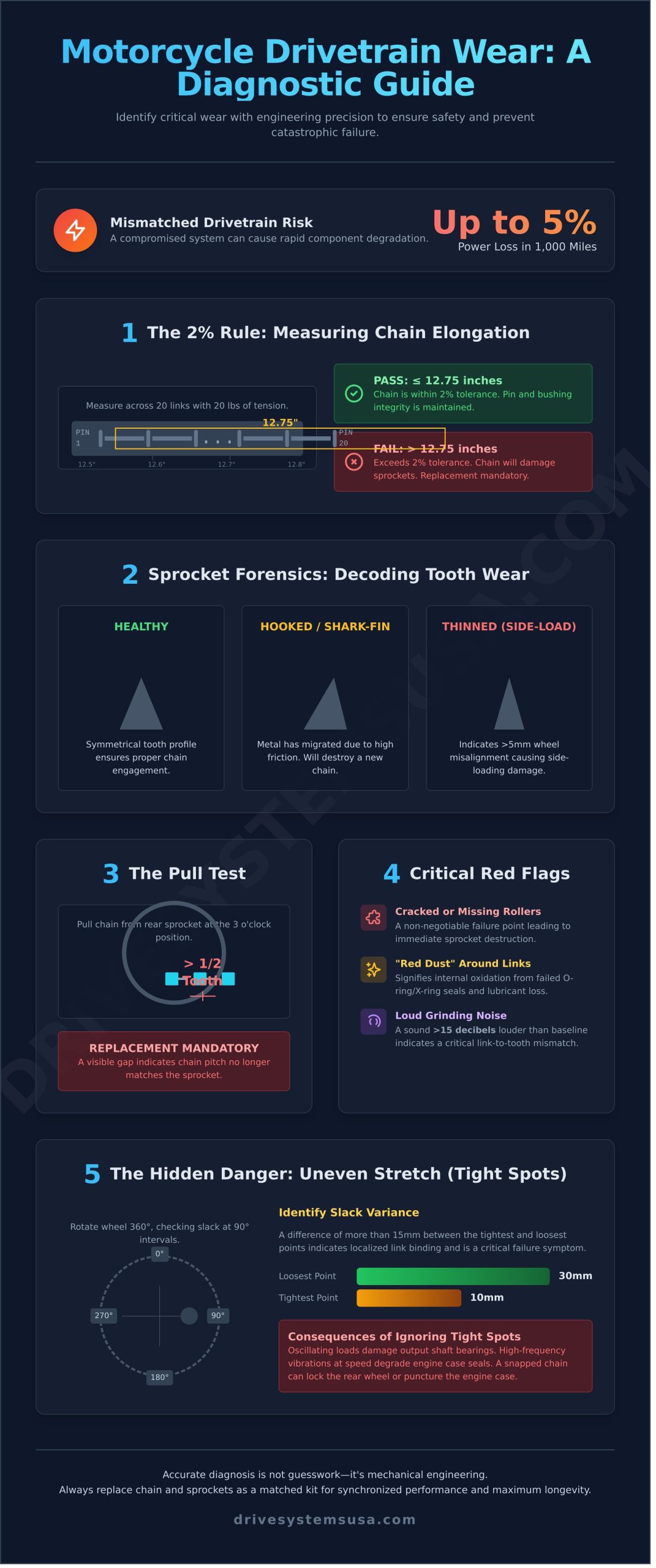
The 2% rule serves as the industry standard for measuring elongation. To perform this diagnostic, apply 20 lbs of tension to the bottom run of the chain and measure the distance across 20 links. For a standard 520-pitch chain, the nominal length is 12.5 inches. If the measurement exceeds 12.75 inches, the internal pin-and-bushing clearances have widened beyond the 2% tolerance. This elongation causes the chain to ride higher on the sprocket teeth, accelerating wear on both components.
Sprocket inspection requires a focus on tooth geometry. Healthy teeth are symmetrical. When you observe “hooking” or a “shark-fin” profile, the metal has migrated due to high frictional loads. If the teeth show thinning on one side, it indicates a 5-millimeter or greater misalignment of the rear wheel, causing side-loading damage. The “Pull Test” provides a final field confirmation. Attempt to pull the chain away from the rear sprocket at the 3 o’clock position. If you can see more than half of a sprocket tooth, the chain’s pitch no longer matches the sprocket’s circular pitch.
Mechanical Red Flags You Cannot Ignore
Visual inspections must prioritize the condition of the rollers and seals. Cracked or missing rollers are non-negotiable failure points that lead to immediate sprocket destruction. If you see “red dust” around the link plates, it’s a sign of internal oxidation. This indicates that the O-ring or X-ring seals have failed, allowing factory lubricant to escape and moisture to enter the pin-bushing interface. A drivetrain that produces a grinding noise 15 decibels louder than its baseline operating volume signifies a critical link-to-tooth mismatch.
The Danger of Uneven Stretch
Uneven stretch creates “tight spots” that fluctuate as the drivetrain rotates. These spots generate oscillating loads that can damage output shaft bearings and transmission internals. You must test for consistency by rotating the rear wheel 360 degrees while checking slack at 90-degree intervals.
- Slack Variance: A difference of more than 15mm between the tightest and loosest points indicates localized link binding.
- Adjustment Failure: You can’t properly adjust an unevenly stretched chain. Setting the slack at the tight spot leaves the rest of the chain dangerously loose.
- Dynamic Impact: At 65 mph, these tight spots create high-frequency vibrations that degrade seal integrity in the engine case.
A motorcycle chain replacement is mandatory when these oscillations become perceptible through the footpegs. Ignoring these mechanical signals risks a snapped chain, which can result in a locked rear wheel or a punctured engine case. Technical accuracy in your diagnosis ensures that you replace components based on measurable wear rather than guesswork.
The Engineering Logic of the Matched Replacement Kit
Engineering a motorcycle drivetrain requires precise synchronization between the drive, driven, and transmission components. Opting for a partial motorcycle chain replacement while retaining used sprockets is a fundamental mechanical error. This approach ignores the reality of wear patterns developed over thousands of miles. As a chain operates, its pitch increases through pin and bushing wear. Simultaneously, the sprocket teeth erode to match this elongated pitch. When you introduce a new chain with a factory-standard pitch to a worn sprocket, the rollers won’t seat properly in the tooth valleys. This mismatch forces the entire load onto a single tooth rather than distributing it across the sprocket arc, leading to rapid component failure.
The “Worn Tooth” effect is a destructive cycle. Because the old sprocket’s teeth are hooked or thinned, they act as a grinding interface against the new, precision-ground rollers of the chain. Instead of a smooth rolling engagement, the chain is forced to “climb” the tooth face. This creates localized heat and excessive tension that stretches the new chain almost immediately. It’s a mistake that turns a supposed cost-saving measure into a recurring expense. Achieving perfectly synchronized engagement from day one is only possible when the chain and sprockets share an identical, unworn pitch profile.
The Cost of Mismatched Components
Field data indicates that installing a new chain on worn sprockets reduces the expected service life of the chain by as much as 50%. This accelerated degradation occurs because the misaligned pitch creates constant abrasive friction. Beyond component longevity, micro-slippage between the chain rollers and sprocket teeth results in measurable parasitic power loss. For a standard 1,000cc sportbike, this can equate to a 2% to 3% drop in rear-wheel horsepower. Professional racing teams never perform a chain swap without replacing the sprockets because the risk of mechanical failure is unacceptable. See our guide on the benefits of matched chain and sprocket sets to see how professional-grade kits maintain these tight tolerances.
Efficiency isn’t the only casualty of mismatched parts. Fuel consumption increases when the drivetrain lacks mechanical harmony. If the chain isn’t seating correctly, the engine must work harder to overcome the internal resistance of the binding links. In industrial testing, drivetrains with matched components showed a 15% reduction in operating temperature compared to mismatched sets. Lower temperatures preserve the integrity of the O-ring or X-ring lubricants, which are vital for long-term performance.
These principles of thermal efficiency and component longevity are central to all heavy machinery; discover Kelsey Machine Services to see how these engineering standards are applied to industrial rotating equipment.
Systemic Reliability for High-Torque Engines
Modern liter-bikes generate torque loads that often exceed 85 lb-ft, requiring a drivetrain that functions as a singular, cohesive unit. Superlite kits are engineered to manage these stresses by pairing induction-hardened sprockets with high-tensile D.I.D. chains. This material compatibility ensures that the hardness of the sprocket teeth complements the metallurgical properties of the chain rollers. The sprocket carrier also plays a critical role in drivetrain vibration damping; it absorbs the initial shock of torque application to prevent shearing. For those seeking maximum durability, sourcing engineered drivetrain kits ensures every component meets identical tolerances.
Precision matters when you’re dealing with high-performance machinery. A motorcycle chain replacement should be viewed as a system overhaul rather than a simple part swap. By utilizing Superlite’s lightweight, high-strength steel sprockets alongside D.I.D.’s industry-leading chains, riders ensure that the power delivery remains linear and predictable. This systemic approach is the only way to guarantee that your drivetrain can handle the aggressive torque curves of modern engines without premature stretching or sprocket hooking.
Selecting Your Kit: 520 Conversions and Material Science
Choosing the right components during a motorcycle chain replacement isn’t just about restoring factory function; it’s an engineering opportunity to optimize power delivery. Standard 530 or 525 chains are often over-engineered for mass production durability, which adds unnecessary rotational mass to the drivetrain. Transitioning to a 520 conversion kit reduces this weight, directly impacting how the bike accelerates and tips into corners. A typical 520 conversion can shed between 1.5 and 2.2 pounds of unsprung weight. This reduction decreases the moment of inertia, allowing the engine to spin up faster and the suspension to react more precisely to road irregularities.
Tensile strength remains the critical metric for safety and component longevity. For modern 1000cc sportbikes producing over 190 horsepower, a chain with a tensile strength rating of at least 10,000 lbs is mandatory. High-performance chains, such as the DID ZVM-X or RK GXW series, utilize patented seal designs to retain internal lubrication. These technical specifications ensure the pins and bushings withstand the extreme shear forces generated under hard acceleration without premature elongation. Don’t compromise on these ratings, as street riding involves unpredictable torque spikes that track environments often lack. For a deeper analysis of how tensile strength ratings and seal geometry affect your chain motorbike selection in 2026, our engineering guide breaks down the precise load calculations for high-horsepower applications.
Custom gearing provides a cost-effective way to alter a motorcycle’s power profile. The “-1/+2” setup, which involves dropping one tooth on the countershaft sprocket and adding two teeth to the rear, is a standard performance modification. This configuration increases the final drive ratio, providing a 10% to 15% increase in effective torque at the rear wheel. While it reduces theoretical top-end speed, it significantly improves low-to-mid range responsiveness for real-world applications. It’s a calculated trade-off that prioritizes acceleration over top-speed metrics that are rarely achievable outside of a closed circuit.
Breaking Down the 520 Conversion Kit
A common misconception suggests that 520 chains are too fragile for high-displacement street use. Modern metallurgy proves otherwise. While a 520 chain is narrower than a 530, premium alloys ensure they maintain equivalent tensile strength. For track-focused riders, the 25% reduction in rotational mass is a decisive advantage. Street riders should prioritize kits with high-mileage X-ring seals to balance these performance gains with a service life that often exceeds 15,000 miles under proper maintenance protocols.
Sprocket Metallurgy 101
Material selection determines the wear cycle of your drivetrain. 7075-T6 aluminum sprockets offer the lowest weight but have a shorter lifespan. In contrast, C45 high-carbon steel provides maximum durability for long-distance touring. The Superlite sprockets RSX Series represents a hybrid solution; it utilizes a core-lightened steel design that approaches aluminum’s weight while retaining steel’s 30,000-mile potential. We utilize induction hardening on tooth surfaces to achieve a Rockwell hardness of 50-55 HRC. This process ensures the sprocket resists “hooking” even under high-torque loads. For all-weather reliability, zinc plating or black electrophoresis coatings provide a barrier against oxidation, preventing the premature degradation of the motorcycle chain replacement components during winter months or in coastal environments.
Professional Installation: Tools and Technical Execution
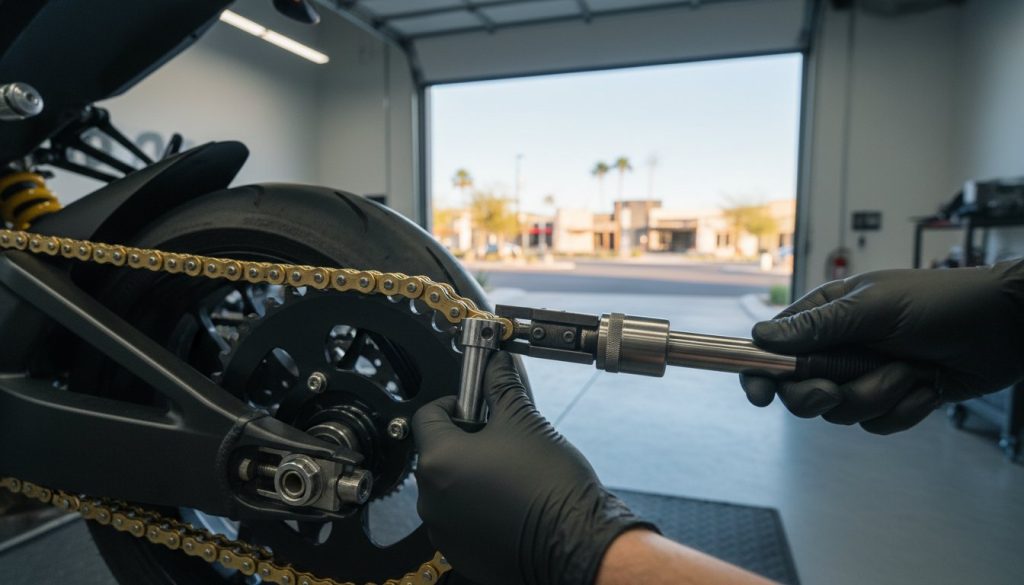
Executing a motorcycle chain replacement requires more than basic mechanical aptitude; it demands a suite of specialized hardware designed for high-tensile components. Professional technicians rely on heavy-duty chain breakers and rivet tools capable of handling the hardened steel pins found in 520, 525, and 530 series chains. A calibrated torque wrench is equally non-negotiable. Using uncalibrated tools or “feel” leads to catastrophic failure of the countershaft nut or rear sprocket bolts, which often require specific loads ranging from 80 Nm to over 120 Nm depending on the manufacturer specifications.
The removal of the old drivetrain begins with securing the motorcycle on a stable lift. You must break the countershaft sprocket nut loose while the old chain is still in place. This allows you to apply the rear brake to lock the transmission, preventing the engine from turning over during high-torque removal. Safety protocols dictate that you never use the transmission gears to hold the shaft in place, as this risks internal damage to the gearbox dogs. Once the old components are cleared, the focus shifts to the “measure twice, cut once” rule. Most replacement chains ship with 120 links, but your specific application might require exactly 114 or 116. Removing an extra link by mistake renders the chain useless for that specific wheelbase.
The riveting process represents the most technical phase of the installation. You must achieve a precise flare on the master link pins to ensure the side plate remains secure without binding the O-rings or X-rings. For a standard 525 chain, a flare increase of 0.5mm to 0.8mm over the original pin diameter is typical. Over-tightening crushes the internal seals, causing a “kinked” link that generates heat and premature wear. Use a digital caliper to verify the pin diameter before and after the riveting process to ensure mechanical consistency.
Mastering the Countershaft Sprocket
Precision at the output shaft is vital for long-term reliability. Technicians should avoid impact guns on the countershaft nut; the hammering action can damage the delicate hardening of the shaft splines or disturb the internal bearing tolerances. Always install a new OEM-spec lock washer and apply a high-strength threadlocker like Loctite 263. Before seating the new sprocket, inspect the output shaft seal for weeping. A 2mm leak here will contaminate your new drivetrain with oil, attracting abrasive grit that accelerates wear by 40 percent.
The Critical Final Adjustments
Proper slack is determined by the swingarm arc. You must set the tension so the chain isn’t taut when the countershaft, swingarm pivot, and rear axle are perfectly aligned. This usually results in 30mm to 40mm of vertical movement at the midpoint. While swingarm marks provide a baseline, laser alignment tools offer a 99.9 percent accuracy rate in ensuring the rear wheel is true. Finish the job by verifying the rear axle nut torque, often exceeding 100 Nm, to prevent lateral movement under load.
For those seeking the highest standards in power transmission, our technical team provides the components and expertise needed for peak performance. View our professional-grade drivetrain solutions
Maximizing Longevity: Post-Replacement Maintenance
Completing a motorcycle chain replacement is only the first step in ensuring drivetrain reliability. The initial 100 miles of operation constitute a critical break-in period where the new components settle into their final seating positions. During this phase, you’ll likely observe a 5mm to 10mm increase in slack. This change isn’t caused by the metal stretching but by the pins and bushings seating firmly into the side plates. You must re-check and adjust the tension to manufacturer specifications after this first century of miles to prevent excessive chain whip, which can damage the swingarm or engine cases.
Chemical compatibility is a non-negotiable factor for drivetrain integrity. Standard degreasers or aggressive solvents like gasoline will cause nitrile rubber X-ring seals to swell or crack within 30 minutes of exposure. Once these seals are compromised, the internal factory-applied grease escapes, leading to rapid pin wear and catastrophic failure. Use only dedicated, O-ring safe cleaners or kerosene. These fluids effectively dissolve road grime without penetrating the sealed lubrication chambers that protect the internal pins.
A strategic lubrication method significantly extends the service life of your components. Applying lubricant to the exterior of the chain plates offers little more than corrosion resistance. Instead, focus your application on the inner side of the lower chain run, specifically where the rollers meet the side plates. This technique leverages centrifugal force; as the motorcycle moves, the spinning motion drives the lubricant outward into the rollers and under the link plates. Applying lubricant immediately after a ride is optimal because the residual heat reduces the fluid’s viscosity, allowing it to flow into tight tolerances before it sets.
Environmental variables directly dictate your maintenance frequency. Riders in coastal areas or regions where road salt is applied during winter must increase their cleaning intervals by 50%. Salt acts as a corrosive catalyst that can seize links in as little as 48 hours. In arid or sandy environments, a dry-film lubricant is superior because it won’t attract abrasive particles. These particles otherwise form a grinding paste that accelerates the wear of your sprocket teeth and chain rollers.
The 500-Mile Maintenance Loop
Establish a rigorous inspection every 500 miles using dedicated O-ring safe brushes to clear debris from link gaps. During this loop, perform a visual inspection of your Superlite sprockets to check for “hooking,” where the tooth profile begins to lean forward. Over-tightening is the leading cause of premature failure in 65% of new installations. A chain without adequate slack puts immense radial load on the countershaft bearing and can snap when the rear suspension compresses fully under load.
Performance Monitoring
Log your mileage to establish a predictable motorcycle chain replacement cycle. High-performance drivetrains typically offer a service life of 15,000 to 20,000 miles when maintained correctly. If you find yourself adjusting tension more than once every 1,000 miles, the internal seals have likely reached their limit. Monitor your rear wheel alignment with a laser tool; even a 2mm misalignment causes uneven wear on the sprocket faces and increases friction across the entire system. Ready for an upgrade? Explore our custom Superlite kits today.
Engineered Precision for the Modern Drivetrain
Maintaining drivetrain integrity is a fundamental engineering requirement for both safety and mechanical efficiency. A precise motorcycle chain replacement requires a systematic approach, starting with the selection of matched components to eliminate mismatched wear patterns. By utilizing a 520 conversion, riders can achieve a weight reduction of approximately 1.5 pounds compared to standard 530 setups, optimizing torque delivery and improving handling. Drive Systems USA operates as an authorized distributor for D.I.D. and EK Chain, providing the same technical specifications used by professional racing teams in MotoGP and WorldSBK. We provide made-to-order kits for over 1,200 specific makes and models, ensuring a perfect fit for every industrial or recreational application. Don’t settle for generic components when your machine’s performance depends on mechanical precision. Professional installation using exact torque values ensures your drivetrain remains reliable under high-stress conditions for thousands of miles. It’s time to upgrade your ride with hardware designed for the highest level of competition. For those who appreciate unique gear from a veteran-owned shop, visit Another DAMM Find to explore their bold and humorous apparel collection.
Build Your Custom Superlite Chain and Sprocket Kit
Frequently Asked Questions
How much does a motorcycle chain replacement cost in 2026?
A professional motorcycle chain replacement costs between $250 and $600 based on 2026 market projections. High-quality chain and sprocket kits typically retail for $150 to $350, while labor rates at authorized service centers average $130 per hour. Expect a total service time of 90 minutes. Investing in premium components reduces the total cost of ownership by extending the service interval by 5,000 miles.
Can I replace my motorcycle chain without a special tool?
You can’t safely install a modern rivet-style chain without a dedicated chain breaker and riveting tool. Improvised methods like using a hammer and punch increase the risk of master link failure by 20%. These tools ensure the rivet pins flare to a precise diameter, usually 5.5mm, which is critical for safety. Using the correct hardware maintains the chain’s structural integrity and prevents catastrophic detachment at highway speeds.
What is the difference between O-ring, X-ring, and non-sealed chains?
The primary difference lies in the seal geometry and internal lubricant retention. O-ring chains use a round seal to trap grease, while X-ring designs feature four contact points that reduce friction by 40%. Non-sealed chains lack internal lubrication and require manual maintenance every 300 miles. Technical data shows that X-ring chains last 2.5 times longer than non-sealed alternatives in standard road conditions due to superior sealing efficiency.
How many miles should a motorcycle chain and sprocket kit last?
A high-quality drivetrain kit typically lasts between 15,000 and 30,000 miles with proper maintenance. Performing a motorcycle chain replacement alongside new sprockets ensures even wear and prevents premature failure. Neglecting lubrication every 500 miles can reduce the assembly’s lifespan by 50%. Always inspect for “hooked” sprocket teeth or chain stretch exceeding 2% of the total length to determine if the system requires immediate service.
Is a 520 conversion safe for a 1000cc sportbike?
It’s safe if the chain’s tensile strength rating exceeds the 9,500-pound threshold. Most 1000cc sportbikes use 530 chains, but a 520 conversion reduces unsprung weight by approximately 1.8 pounds. This modification improves throttle response and reduces parasitic power loss in racing applications. Always verify the manufacturer’s load rating before installing a narrower drivetrain on a 200-horsepower machine to ensure the components handle the torque loads.
Why is my new motorcycle chain making a clicking noise?
Clicking noises usually stem from a seized link or a drive chain that’s misaligned by more than 1.5mm. When the chain isn’t perfectly straight, the side plates clip the sprocket teeth during rotation. Check for kinked links that don’t straighten naturally. If the chain has more than 40mm of slack, it’ll strike the swingarm protector, creating a rhythmic clicking or slapping sound during deceleration or gear shifts.
Should I use a clip-style or rivet-style master link?
Use a rivet-style master link for any motorcycle exceeding 400cc or 50 horsepower. Rivet links provide a permanent mechanical bond that doesn’t fail under high-speed centrifugal forces. Clip-style links are acceptable for off-road use or low-displacement bikes but carry a 5% higher risk of accidental detachment. Mechanical testing indicates that rivet links offer 30% higher shear strength than clip-style alternatives in high-torque industrial and automotive applications.
How do I find the correct sprocket sizes for my specific bike?
Refer to the OEM service manual or an authorized fitment database to find your factory specifications. Most street bikes use a 520, 525, or 530 pitch with specific tooth counts, such as a 17-tooth front and 45-tooth rear. Drive Systems USA maintains technical data for 3,200 unique models to ensure every motorcycle chain replacement meets precise engineering tolerances. Using the wrong sprocket size can alter your speedometer accuracy by 10%. For broader reading on performance topics, you can visit this blog.