
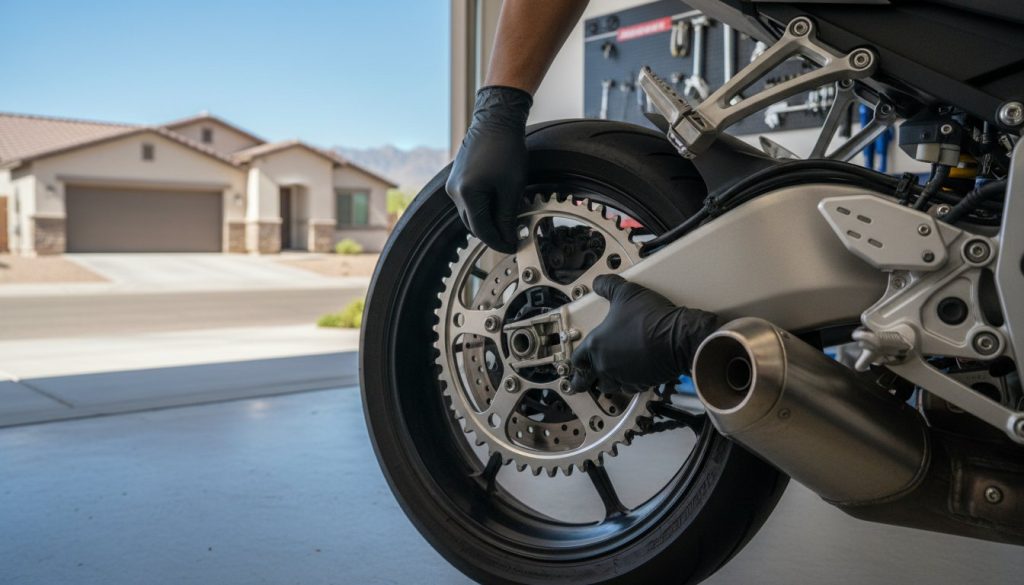
A 10% reduction in rotating mass at the drivetrain often improves acceleration more effectively than a 5-horsepower gain at the crank. Choosing the correct moto sprocket isn’t merely a matter of routine maintenance; it’s a deliberate engineering decision that dictates how power reaches the ground. You’ve likely experienced the technical confusion that comes with selecting between 520 and 525 pitch sizes or worried that a lightweight material might fail under high-torque loads. These concerns are valid, as incorrect gearing leads to speedometer inaccuracies and accelerated chain wear.
We’re here to provide the technical clarity required to optimize your motorcycle’s performance and drivetrain longevity. This guide breaks down the relationship between gear ratios and engine stress, helping you identify critical wear patterns before they become dangerous. We’ll explore the science of material selection and explain why a precision-engineered Superlite kit is the definitive solution for riders seeking a balance of strength and efficiency.
Key Takeaways
- Understand the mechanical distinction between sprockets and gears and why standardized pitch dimensions are critical for drivetrain integration.
- Evaluate the performance tradeoffs between high-carbon steel and 7075-T6 aluminum to align component longevity with your specific torque requirements.
- Learn to identify critical wear patterns like “shark-fining” and utilize the chain pull test to ensure optimal drivetrain health.
- Master the selection process for a new moto sprocket by analyzing riding environments and determining if OEM specs or custom gearing ratios best serve your performance objectives.
- Discover how tooth profile geometry affects chain roller engagement to optimize power transmission and reduce mechanical friction.
What is a Moto Sprocket? Defining the Core of Your Drivetrain
A moto sprocket is a precision-engineered profiled wheel with teeth designed to mesh with a roller chain for the transmission of rotary motion. While often confused with gears, the mechanical distinction is critical for drivetrain optimization. Gears transmit power through direct contact with other gears; sprockets transmit power by engaging the individual links of a chain. For those seeking a deeper technical background on the history and physics of these components, understanding What is a sprocket? provides the necessary foundation for evaluating drive system performance.
The motorcycle drivetrain relies on a two-part system: the front countershaft sprocket and the rear drive sprocket. This configuration serves as the final stage of power transmission before the tire meets the pavement or dirt. Adjusting the ratio between these two components is the most cost-effective method for a technician to alter a motorcycle’s personality. By changing the tooth count, an engineer can prioritize either rapid acceleration or higher top-end velocity without modifying internal engine components. It’s a standard procedure for tailoring a machine to specific track layouts or riding conditions.
The Role of the Countershaft Sprocket
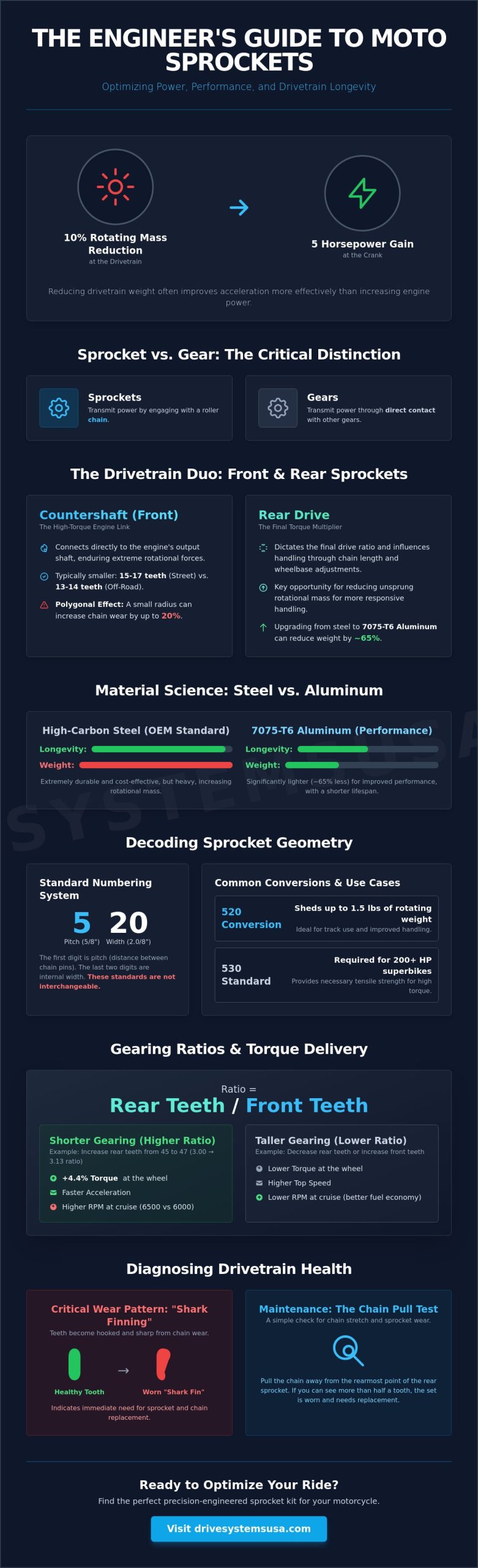
The countershaft sprocket connects directly to the engine’s output shaft, placing it in a high-torque environment where it must withstand extreme rotational forces. It’s typically the smaller of the two sprockets. High-performance street applications usually feature 15 to 17 teeth, whereas off-road applications might drop to 13 or 14 teeth to maximize torque. Smaller front sprockets are prone to the polygonal effect, where the chain speed fluctuates as it moves around the small radius. This effect increases mechanical vibration and can accelerate chain wear by as much as 20% if the diameter is too restrictive.
The Role of the Rear Drive Sprocket
The rear drive sprocket acts as the final torque multiplier for the rear wheel. Its diameter dictates the final drive ratio and influences the overall wheelbase by requiring specific chain lengths. Beyond ratio adjustments, the rear moto sprocket represents a significant opportunity for reducing unsprung rotational mass. Standard OEM steel sprockets are durable but heavy. Utilizing a precision-machined 7075-T6 aluminum rear sprocket can reduce component weight by approximately 65%. This reduction improves the suspension’s ability to track terrain and decreases the energy required to initiate wheel rotation, leading to more responsive handling.
The Engineering of Power: How Sprocket Geometry Affects Performance
The standard numbering system for a moto sprocket relies on specific imperial measurements that define its compatibility and strength. The first digit, five, represents the pitch, which is the distance between pin centers measured as five-eighths of an inch. The subsequent two digits indicate the internal width between the inner plates. A 520 chain measures 2.0 eighths of an inch wide, while a 530 measures 3.0 eighths. These standards aren’t interchangeable. Mismatched widths cause immediate lateral instability or mechanical interference that can lead to catastrophic chain failure.
Pitch and Width Standards Explained
Track enthusiasts often choose a 520 conversion to reduce mass. This swap can shed up to 1.5 pounds of rotating weight, which improves flickability in corners and reduces the energy required to spin the drivetrain. However, 1000cc superbikes producing over 200 horsepower typically require the 530 standard. The wider plates provide the necessary tensile strength to manage high torque loads without premature stretching or snapping under load.
Gearing Ratios and Torque Delivery
Gearing ratios dictate how the engine’s power reaches the asphalt. You calculate this by dividing the number of rear teeth by the front teeth. For example, a 15-tooth front and 45-tooth rear sprocket yield a 3.00 ratio. Increasing this number, perhaps by adding two teeth to the rear, results in shorter gearing. This modification provides a 4.4 percent increase in torque at the wheel, which aids rapid acceleration out of slow corners.
The trade-off for increased acceleration involves higher engine speeds. At a steady 70 mph, a bike with shorter gearing might spin at 6,500 RPM instead of 6,000 RPM. This increases vibration and reduces fuel efficiency during long-distance transit. It’s a balance between aggressive power delivery and mechanical comfort. If you’re looking to optimize your drivetrain for specific track conditions, exploring engineered sprocket solutions can provide the necessary precision for your build.
The geometry of the tooth profile determines the longevity of the entire drive system. Precision-machined sprockets feature specific pressure angles that allow chain rollers to seat deeply into the valleys. If the valley is too shallow, the rollers “hook” the teeth, which accelerates wear. Beyond simple gear ratios, the physical weight of the moto sprocket affects the motorcycle’s handling. A heavier steel sprocket increases gyroscopic forces, making the bike more resistant to rapid lean angle changes.
High-performance applications often utilize 7075-T6 aluminum to minimize this rotational inertia. Reducing unsprung mass by even 500 grams allows the rear shock to react more quickly to road imperfections. This improvement in suspension response ensures the tire maintains a consistent contact patch, providing better grip during aggressive maneuvers. Every gram of weight saved on the sprocket has a 4x greater impact on performance than weight saved on the frame because of its rotational nature.
Steel vs. Aluminum: The Metallurgy of Modern Moto Sprockets
Selecting a moto sprocket requires a precise balance between tensile strength and rotational inertia. High-carbon steel remains the industrial benchmark for longevity. Alloys like C45 or SCM415 provide the surface hardness necessary to withstand the high torque loads generated by modern engines. Engineers utilize induction hardening on these steel components to reach a Rockwell hardness of 50 to 55 HRC. This specific heat treatment limits “hooking,” a condition where chain rollers deform the tooth profile over thousands of engagement cycles.
7075-T6 aluminum offers a performance-oriented alternative. This aerospace-grade alloy has a yield strength of approximately 73,000 psi, which is remarkably high for its mass. It reduces the weight of the rear assembly by up to 70% compared to steel. This reduction in unsprung mass improves the suspension’s ability to react to surface irregularities. Hybrid designs, which rivet a steel outer ring to an aluminum carrier, bridge the gap. These units offer the 20,000-mile durability of steel with a 40% weight reduction over solid steel parts.
Surface treatments are critical for maintaining mechanical integrity. The industry relies on several primary processes:
- Zinc Plating: Standard on steel to prevent oxidation and environmental corrosion.
- Type III Hard-Anodizing: Creates a thick, ceramic-like oxide layer on aluminum to increase abrasion resistance.
- Induction Hardening: Targets the tooth area of a moto sprocket to ensure the core remains ductile while the contact surface stays rigid.
When to Choose Steel Sprockets
Steel is the definitive choice for daily commuters and long-distance tourers. The material’s density allows it to resist the abrasive wear caused by road grit and salt. A high-quality steel sprocket can reliably exceed 15,000 miles of service. It’s the most cost-effective solution for high-torque cruisers where weight is less critical than component life. Owners who prioritize a “fit and forget” maintenance schedule will find steel’s stability unmatched.
When to Choose Aluminum Sprockets
Aluminum is the standard for motocross, road racing, and performance-focused custom builds. Reducing rotational mass allows the engine to spool up faster, providing a measurable gain in throttle response. Hard-anodizing is a non-negotiable requirement for these applications; without it, the chain would compromise the alloy’s structural integrity within a few thousand miles. Choose aluminum when every fraction of a second on the track or every pound of weight on a lightweight build matters. For a deeper understanding of how chain pitch specifications interact with sprocket material selection, our comprehensive guide to motorcycle chain sprocket systems covers the full technical spectrum of secondary drive optimization.
Diagnosing Drivetrain Health: Wear Patterns and Replacement Indicators
Common Failure Modes
Mechanical wear typically manifests in three distinct patterns. Hooking occurs when the tooth profile deforms toward the direction of rotation; this usually indicates the component has exceeded its fatigue life under high torque loads. Thinning refers to the loss of lateral material on the tooth faces, often suggesting a misalignment of the rear wheel by as little as 2 millimeters. Pitting involves small craters forming on the tooth surface, which signals a breakdown in lubrication or surface hardening failure.
Visual cues like “shark-fining” are definitive indicators for replacement. When teeth lose their symmetrical “V” shape and begin to resemble a wave, the sprocket’s ability to shed the chain rollers during rotation is compromised. This profile change increases friction and heat, which eventually leads to tooth shear under load.
The “Chain Pull” test provides a quantitative measure of wear. Pull the chain away from the rear moto sprocket at the 3 o’clock position. If the gap exposes more than 50 percent of the tooth height, the pitch of the chain no longer matches the sprocket geometry. This mismatch indicates that the internal bushings of the chain have worn down, effectively increasing its length.
Auditory cues also serve as diagnostic tools. A rhythmic clicking often signals a seized link or a bent tooth. Constant grinding or excessive whirring sounds usually point to severe lateral misalignment that forces the chain plates against the sprocket face, causing premature side-wall thinning.
The Dangers of Mismatched Wear
Installing a new chain on worn sprockets is a significant technical error. The elongated pitch of a worn sprocket forces the new chain to carry the entire load on a single tooth rather than distributing it across the arc of engagement. This increases localized pressure by approximately 300 percent, which causes the new chain to “stretch” almost immediately as the rollers are forced into the incorrect tooth valleys.
- Vibration Issues: Uneven wear patterns create harmonic vibrations that can damage countershaft bearings.
- Safety Risks: Hooked teeth can “hook” the chain rollers, preventing them from releasing and causing the chain to wrap around the drive sprocket.
- Efficiency Loss: Worn profiles increase mechanical drag, reducing rear-wheel horsepower by 2 to 5 percent.
Always replace the front sprocket, rear sprocket, and chain as a matched set to ensure the pitch diameters remain synchronized. This practice maximizes the service life of every component in the system.
Ensure your drivetrain operates with maximum precision by selecting engineered components from Drive Systems USA.
Optimizing Your Ride: Selecting the Best Moto Sprocket Configuration
Selecting the correct moto sprocket requires a systematic evaluation of your machine’s operational requirements. Start by identifying your primary riding environment. Commuters typically prioritize a service life exceeding 20,000 miles, while track riders require gear ratios that maximize acceleration out of specific corners. Trail riders often demand a 10% to 15% increase in low-end torque to handle technical terrain and steep inclines.
Next, determine if you need a gearing change or an OEM-spec replacement. Altering the tooth count by just one in the front or three in the rear significantly shifts the power band. Choose your material based on maintenance capacity and performance goals. Carbon steel provides maximum durability for high-mileage applications. Hard-anodized aluminum offers a 60% weight reduction for performance-critical scenarios. Always verify fitment by cross-referencing your bike’s specific make, model, and year against manufacturer technical drawings to ensure the bolt circle diameter is exact. Even a 0.5mm variance can lead to catastrophic failure under high torque loads.
- Step 1: Define your environment to prioritize either longevity or immediate throttle response.
- Step 2: Calculate your desired final drive ratio to decide between stock teeth or custom gearing.
- Step 3: Select induction-hardened steel for utility or 7075-T6 aluminum for racing.
- Step 4: Confirm the pitch size, such as 520, 525, or 530, to match your chain.
The Superlite Philosophy: Precision Machined in the USA
Superlite sprockets utilize proprietary steel alloys to achieve superior strength-to-weight ratios. Their engineers employ “drilled” designs that remove material from non-load-bearing areas without compromising the structural integrity of the steel. Drive Systems USA maintains strict tolerances during the machining process to ensure perfect concentricity. Parts that run true reduce vibration and ensure consistent power delivery to the rear wheel, preventing premature wear on the countershaft bearings.
Final Recommendations for the 2026 Rider
Current trends show a 40% increase in 520 conversions for modern middleweight machines. This modification reduces rotational mass, which improves throttle response and braking efficiency. For a complete drive system, integrate your moto sprocket with high-performance chains from D.I.D or EK. These systems work in tandem to minimize friction and extend the replacement interval. Browse our complete Superlite Sprocket kits for your bike here to ensure your drivetrain operates at peak efficiency.
Engineered Precision for Peak Drivetrain Performance
Selecting the right moto sprocket is a critical decision that directly impacts power delivery and mechanical longevity. We’ve examined how tooth geometry and material science, specifically the choice between hardened steel and lightweight aluminum, determine the efficiency of your drivetrain. Proper maintenance depends on your ability to identify specific wear patterns before they lead to component failure. By prioritizing precision over generic replacements, you optimize every horsepower your engine produces.
Drive Systems USA serves as a dedicated partner for riders who demand industrial-grade reliability. We’re an authorized distributor of D.I.D and EK Chains, ensuring that your system utilizes the most trusted names in the industry. Our Superlite Sprockets represent the strongest and lightest steel options available today, designed to withstand extreme torque loads without unnecessary mass. If you have technical questions, our expert support team is based in Gilbert, Arizona, ready to provide specific gearing solutions for your unique application requirements. Don’t settle for standard performance when engineered excellence is within reach.
Build your custom Superlite Chain and Sprocket Kit today
Frequently Asked Questions
How long should a typical motorcycle sprocket last?
A high-quality steel moto sprocket typically lasts between 15,000 and 20,000 miles when paired with a well-maintained chain. Aluminum variants offer less durability, usually requiring replacement after 3,000 to 5,000 miles of use. You’ll maximize component life by maintaining proper chain tension and applying lubricant every 500 miles to prevent abrasive wear on the tooth profiles.
Can I change just the front sprocket to get more acceleration?
You can increase acceleration by installing a front sprocket with one fewer tooth than the factory specification. This modification shortens the final drive ratio, which provides more torque at the rear wheel but reduces top-end speed by approximately 5% to 7%. It’s an efficient solution for riders seeking better low-end response without the expense of a full drivetrain overhaul.
What is the difference between a 520 and a 525 sprocket?
The primary difference lies in the internal width of the sprocket teeth, where a 520 sprocket measures 6.35 mm and a 525 measures 7.94 mm. While both share a 15.875 mm pitch, the 520 version is narrower and lighter to reduce rotating mass. Engineers specify the 525 size for high-horsepower machines to provide a larger contact patch and greater lateral stability under heavy torque loads.
Do aluminum sprockets wear out much faster than steel?
Aluminum sprockets wear out roughly three times faster than induction-hardened steel alternatives because the material has lower surface hardness. Most 7075-T6 aluminum sprockets are designed for racing applications where reducing unsprung weight by 60% is more critical than long-term durability. For daily commuting or long-distance touring, steel remains the industry standard for achieving 20,000 miles of reliable service.
Will changing my sprocket size affect my speedometer reading?
Changing your moto sprocket size will alter your speedometer accuracy if the speed sensor is mounted to the engine’s countershaft or transmission. A 10% change in the gearing ratio will result in a 10% error in the displayed speed and odometer mileage. Motorcycles that utilize wheel-mounted ABS sensors for speed tracking don’t experience this issue because they measure the actual rotation of the tire.
How do I know what my current gearing ratio is?
You calculate your gearing ratio by dividing the number of teeth on the rear sprocket by the number of teeth on the front sprocket. A motorcycle with a 45-tooth rear and a 15-tooth front has a final drive ratio of 3.00:1. If you increase this number, you’re gearing the bike down for more torque; if you decrease it, you’re gearing it up for higher speeds.
Is it hard to replace motorcycle sprockets myself?
Replacing sprockets is a moderate mechanical task that usually takes an experienced hobbyist about 90 to 120 minutes to complete. You’ll need specific tools, including a torque wrench, a rear stand, and a chain riveting tool to secure the new master link. Precise alignment of the rear wheel within a 0.5 mm tolerance is vital to prevent accelerated wear on the new drivetrain components.
What are the benefits of a 520 chain conversion kit?
A 520 chain conversion kit reduces the drivetrain’s rotating mass by up to 2.5 pounds compared to a standard 530 setup. This reduction in inertia allows the engine to transfer power to the ground more efficiently, resulting in sharper throttle response and improved flickability in corners. It’s the most common performance upgrade for track-oriented motorcycles where optimizing the power-to-weight ratio is a primary objective. Riders evaluating this upgrade can benefit from reviewing the technical specifications outlined in our motorcycle chain and sprocket systems guide to ensure proper component matching across the entire secondary drive.