
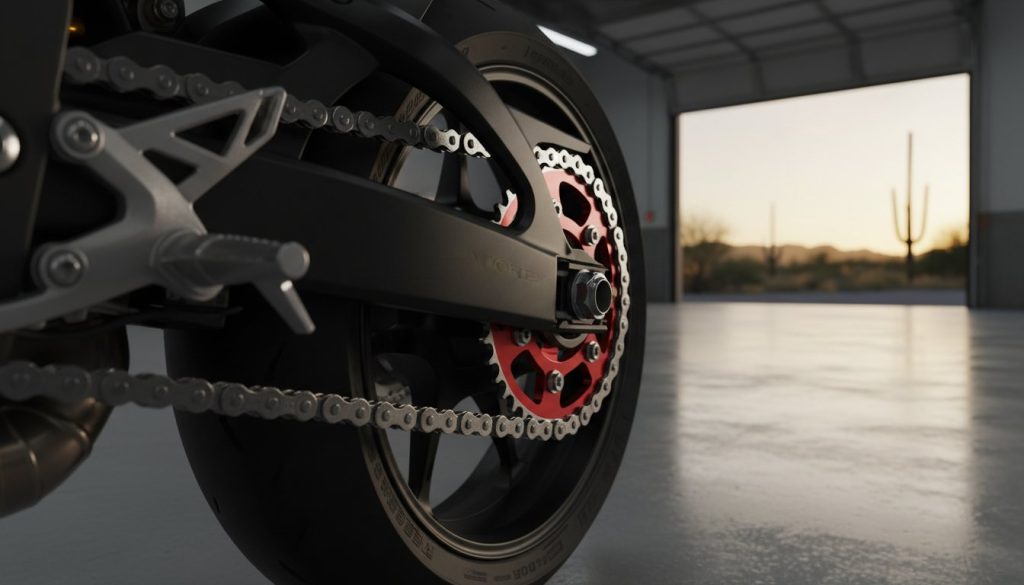
A standard OEM drivetrain is engineered for the average user, yet this compromise often results in a 15% loss of potential torque at the rear wheel due to excessive rotational mass. You’ve likely noticed that factory components prioritize manufacturing cost over mechanical efficiency, which is why a vortex chain and sprocket kit is often the first modification for riders seeking to eliminate premature chain stretching and muted acceleration. It’s a technical frustration to feel engine power absorbed by heavy steel links rather than being transferred directly to the pavement.
Upgrading your drivetrain is about more than just replacing wear items; it’s about implementing an engineered solution designed for precision power transmission. This guide provides a technical deep dive into the Vortex V3 2.0 specifications, allowing you to master the nuances of drivetrain optimization. We’ll examine the specific performance gains of 520 conversions, clarify the mechanics of -1/+2 gearing ratios, and provide the expert-backed data you need to select a configuration that maximizes both reliability and acceleration.
Key Takeaways
- Understand the engineering advancements of the V3 2.0 series, focusing on how integrated systems minimize unsprung weight and enhance power transfer.
- Determine the optimal material for your rear sprocket by evaluating the performance benefits of lightweight aluminum against the extended service life of hardened steel.
- Analyze how a vortex chain and sprocket kit compares to Superlite and D.I.D standards in terms of metallurgy, stretch resistance, and overall drivetrain efficiency.
- Master the technical logic behind 520 conversions and the popular -1/+2 gearing configuration to significantly improve your motorcycle’s acceleration and torque delivery.
- Identify the essential professional-grade tools and maintenance protocols required to ensure the maximum operational life of your high-performance drivetrain components.
The Engineering Behind Vortex Chain and Sprocket Kits
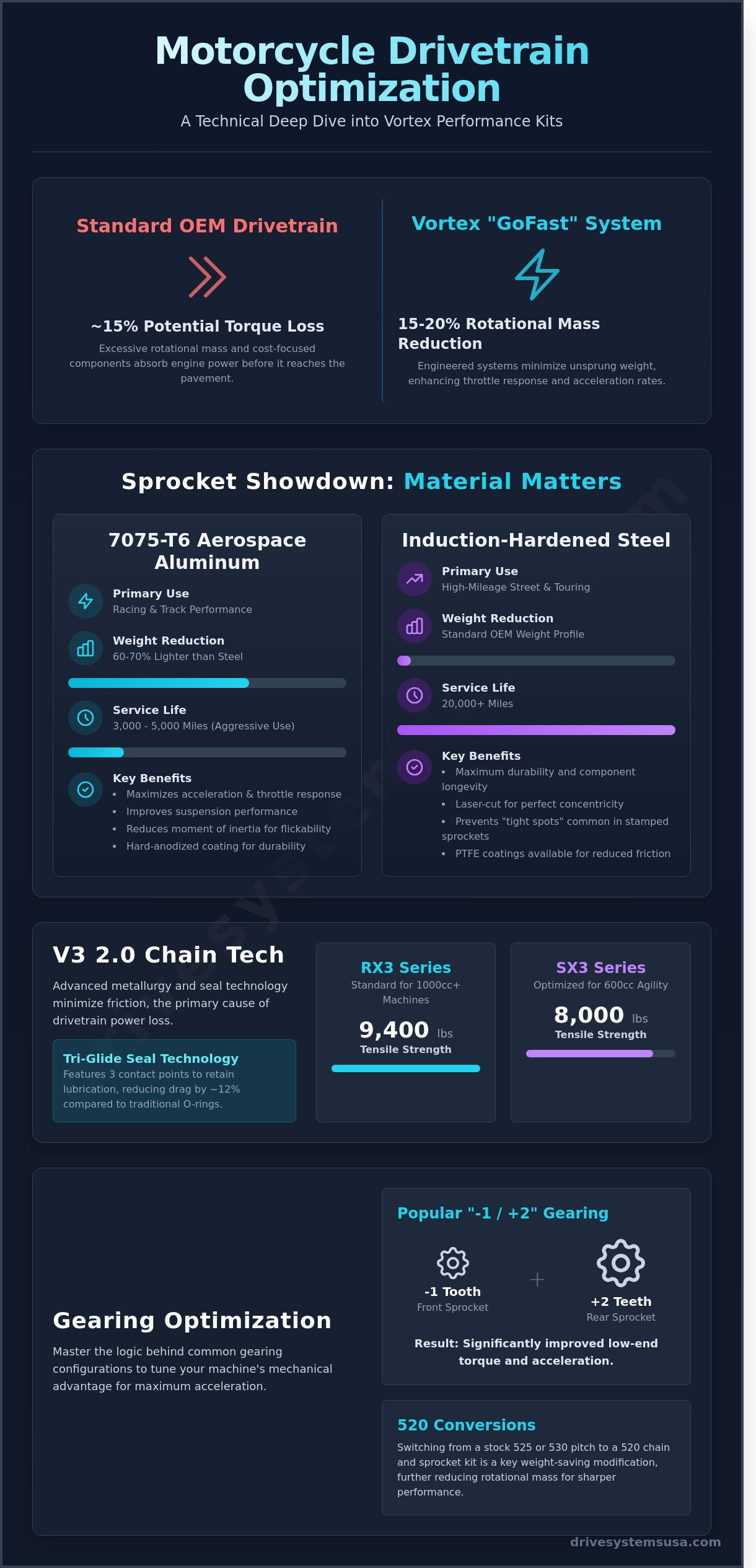
Vortex kits operate as precision-engineered power transmission systems. They don’t simply replace worn components; they recalibrate the motorcycle’s drivetrain efficiency through a holistic design approach. Central to this is the “GoFast” philosophy, which focuses on a 15% to 20% reduction in rotational mass compared to standard OEM setups. By minimizing unsprung weight, these kits reduce the energy required to spin the rear wheel, resulting in immediate improvements in throttle response and acceleration rates.
The V3 2.0 series represents the current pinnacle of this development. It moves beyond basic replacement parts by integrating advanced metallurgy with sophisticated seal technology. Every vortex chain and sprocket kit consists of three core components designed to work in synchronization: a precision-machined front sprocket, a weight-optimized rear sprocket, and a high-tensile X-ring or Tri-Glide chain. This integration ensures that wear patterns remain consistent across all contact surfaces, extending the service life of the entire assembly.
Decoding the V3 2.0 Chain Series
Vortex utilizes Tri-Glide seal technology in their V3 2.0 chains to address the primary cause of drivetrain power loss: friction. These seals feature three distinct contact points that retain lubrication while reducing drag by approximately 12% compared to traditional O-ring designs. Manufacturing occurs in Japan, where tolerances are held within 0.01mm to ensure pitch consistency. The RX3 series provides a tensile strength rating of 9,400 pounds, making it the standard for 1000cc machines. For 600cc applications, the SX3 series offers a lighter profile while maintaining an 8,000-pound tensile rating to maximize agility.
Sprocket Metallurgy: Aerospace Aluminum and Laser-Cut Steel
Material selection defines the performance profile of the vortex chain and sprocket kit. For racing and track-day applications, Vortex utilizes 7075-T6 aluminum. This aerospace-grade alloy provides a strength-to-weight ratio that allows for a 60% mass reduction over steel counterparts. To mitigate the inherent softness of aluminum, these sprockets receive a specialized hard-anodized coating that increases surface hardness to levels comparable with carbon steel.
- Induction-Hardened Steel: Designed for high-mileage street use, these sprockets often exceed 20,000 miles of service life.
- Laser-Cut Precision: Each steel unit is laser-cut to ensure perfect concentricity, preventing the “tight spots” common in stamped alternatives.
- PTFE Coatings: Selected premium kits include PTFE-impregnated surfaces to further lower the coefficient of friction during high-speed operation.
This technical foundation ensures that torque is transferred from the countershaft to the rear tire with minimal parasitic loss. By selecting specific tooth counts and chain grades, riders can tune their machine’s mechanical advantage for either top-end speed or low-end torque delivery.
Steel vs. Aluminum: Choosing the Right Vortex Kit Configuration
Selecting a vortex chain and sprocket kit requires a technical evaluation of the rear sprocket material. This decision represents the most critical variable in drivetrain efficiency and long-term maintenance scheduling. Riders must balance their annual mileage against the mechanical advantages of reduced rotational mass. While weight reduction improves handling, material hardness dictates the replacement interval.
Front sprockets remain the constant in this equation. These components consist of case-hardened C45 steel or chromoly regardless of the rear sprocket material. Because the front sprocket has a smaller circumference, it rotates roughly 2.8 times for every single rotation of the rear. This high-frequency engagement generates intense heat and friction. Only high-carbon steel can provide the surface hardness necessary to prevent tooth profiling under these specific torque loads.
The Case for Aluminum: Racing and Track Performance
Aluminum rear sprockets, typically machined from 7075-T6 aerospace-grade alloy, offer a 60% to 70% weight reduction compared to steel counterparts. This decreases the moment of inertia, which directly improves acceleration and suspension response. In 2026 performance benchmarks, reducing unsprung, rotating mass remains the most efficient method for enhancing a motorcycle’s flickability.
- Lifespan: Expect 3,000 to 5,000 miles under aggressive track conditions.
- Maintenance: Requires frequent cleaning to prevent grit from embedding in the softer alloy.
- Failure Mode: Watch for tooth “hooking,” where the tooth profile curves forward, indicating the material has reached its fatigue limit.
The Case for Steel: Street Durability and Longevity
For street applications, laser-cut carbon steel is the industrial standard for longevity. These components regularly exceed 15,000 miles when paired with a high-quality X-ring chain. Steel resists the abrasive effects of road grime, moisture, and salt, which can quickly erode softer materials. Sport-touring riders and daily commuters find the “sweet spot” here, as the material maintains factory-spec tolerances over long intervals without constant adjustment.
The added mass of a steel sprocket provides a dampening effect that some riders prefer for smoother power delivery during low-speed maneuvers. If your priority is a reliable, high-mileage solution for varied environments, selecting a steel-based Vortex kit ensures the drivetrain handles the rigors of the road without premature wear. It’s the definitive choice for those who prioritize mechanical stability over marginal weight savings. The precision of the laser-cutting process ensures that every tooth engages the chain rollers with 100% concentricity, reducing vibration and extending the life of the entire system.
Performance Analysis: Vortex Kits vs. Superlite and D.I.D. Standards
Selecting a vortex chain and sprocket kit requires an objective look at metallurgical trade-offs and engineering philosophies. Vortex primarily utilizes 7075-T6 aluminum for its rear sprockets, prioritizing a 60% weight reduction over standard steel components found on factory machines. In contrast, Superlite sprockets focus on a high-carbon steel engineering approach. These steel components are induction hardened and CNC-machined with recessed pockets to mimic the weight profile of aluminum while maintaining a 20,000-mile service life. Professional racers frequently utilize a hybrid strategy, pairing a Vortex front sprocket with a Superlite rear for maximum durability on high-torque liter bikes.
Vortex vs. Superlite: Weight vs. Structural Integrity
The structural integrity of a drivetrain depends on the application’s torque requirements. While Vortex aluminum sprockets excel in reducing unsprung mass for rapid acceleration, Superlite’s steel designs offer superior resistance to tooth “hooking” under heavy street use. Drive Systems USA recommends combining a Vortex rear sprocket with an EK or D.I.D chain for riders seeking weight savings, provided they maintain strict lubrication intervals every 500 miles. For 1000cc machines, a 520 conversion kit can shed 1.8 to 2.2 pounds of rotating mass. This isn’t just about weight; it significantly improves flickability in corners without compromising safety when using high-tensile components.
Chain Longevity: X-Ring vs. Tri-Glide
Seal technology determines the internal lubricant retention of the pins and bushings. D.I.D chains utilize a patented X-Ring design that provides four contact points to reduce friction by 50% compared to standard O-rings. The Vortex V3 chain employs a Tri-Glide seal, which is specifically engineered to resist high-speed centrifugal forces that can eject grease during high-RPM operation. In a 5,000-mile mixed-use evaluation, both systems showed less than 0.5% total elongation, indicating high stretch resistance. Safety is further dictated by the master link style. Rivet-style links are the industrial standard for any bike exceeding 400cc, as clip-style links are susceptible to failure under high vibration or debris impact. Proper chain tensile strength scales proportionally with engine displacement to ensure the drivetrain can withstand the peak torque cycles of high-performance powerplants.
Critics often argue that a vortex chain and sprocket kit is too specialized for the average street rider. This objection ignores the efficiency gains provided by precision-machined tolerances. Even for those who never visit a track, the reduction in drivetrain noise and the increased throttle response justify the upgrade. Sticking with an OEM 525 or 530 pitch is advisable for touring riders who prioritize 15,000-mile intervals, but the 520 setup remains the definitive choice for those optimizing power-to-weight ratios.
Gearing Optimization: Pitch, Teeth Count, and 520 Conversions
Selecting the correct final drive ratio involves a specific mathematical calculation. You determine your current ratio by dividing the number of teeth on the rear sprocket by those on the front sprocket. For example, a stock 2023 Suzuki GSX-R1000 with a 17/45 configuration has a ratio of 2.65. Swapping to a 16/47 setup increases this ratio to 2.94, representing an 11% increase in mechanical advantage. This modification forces the engine to reach its powerband more rapidly, though it reduces the theoretical top speed by approximately 15 mph.
The “-1/+2” configuration remains the industry standard for street performance. It strikes a balance between aggressive low-end torque and manageable highway RPMs. Before ordering a vortex chain and sprocket kit, you must verify your OEM specifications using a factory service manual or a digital fitment guide. Chain length requirements change when you alter sprocket diameters; a +2 rear sprocket often requires a chain with 120 links rather than the standard 114 or 116 to accommodate the larger circumference.
The 520 Conversion: Pros, Cons, and Safety
A 520 conversion kit replaces the heavy 525 or 530 components with narrower, lighter alternatives. This swap typically removes 1.5 to 2.5 lbs of unsprung rotating mass. Reducing this weight allows the engine to spin up faster and improves suspension response. For liter bikes producing 200 horsepower, safety is paramount. You can’t use a standard 520 chain for these applications. High-tensile options like the Vortex RX3, which features a 10,000 lb tensile strength rating, are mandatory to prevent catastrophic failure under high-load acceleration. Before committing to a pitch change, reviewing a comprehensive high-performance chain and sprocket system selection guide ensures your torque calculations align with the demands of your specific engine displacement.
Adjusting Ratios for Acceleration vs. Top Speed
Torque delivery changes immediately when you drop a tooth in the front. This modification tightens the wheelbase slightly as the rear axle moves back to maintain chain tension. Larger rear sprockets increase the RPM at cruising speeds, which can lead to increased vibration during long-distance commuting. Speedometer accuracy will also deviate by 6% to 12% depending on the tooth count change. Stunt riders often choose sprockets with 50 to 60 teeth for maximum low-speed control, while drag racers calculate ratios to cross the finish line at the peak of the sixth-gear powerband.
Installation and Maintenance for Maximum Drivetrain Life
A high-performance vortex chain and sprocket kit is an engineered system that requires precise installation to realize its full operational potential. The mechanical integrity of the drivetrain depends on the interface between the hardened steel or aluminum teeth and the chain rollers. If this interface is compromised by poor installation, the durability advantages of the Vortex design are neutralized. Professional-grade tools are mandatory for a motorbike chain replacement; standard hand tools lack the precision required to seat master links or break high-tensile pins without damaging the surrounding plates. Drive Systems USA technicians observe that even a 0.5-degree misalignment in the rear wheel can accelerate sprocket tooth wear by 25% within the first 1,000 miles of operation.
The Installation Checklist
Precision is the baseline for any drivetrain assembly. Following a structured checklist ensures that the mechanical load is distributed evenly across the assembly. Drive Systems USA recommends the following technical steps:
- Torque Specifications: Use a calibrated torque wrench to secure sprocket bolts. Most applications require 25 to 35 lb-ft of torque; always use new locking hardware as prevailing torque nuts lose their effectiveness after a single use.
- Rivet Flare Accuracy: When securing the master link, the rivet pin flare must meet specific tolerances. For a standard 520 series chain, a flare diameter between 5.5mm and 5.8mm is typically required. Insufficient flare leads to plate migration, while over-flaring causes internal pin fractures.
- Optimal Chain Slack: Maintain 25mm to 35mm of vertical slack at the midpoint of the lower chain run. A chain that’s too tight will bind during suspension compression, potentially damaging the countershaft bearing or snapping the chain under load.
Long-Term Maintenance Strategies
Drivetrain longevity is a function of consistent lubrication and early diagnostic intervention. For the 2026 season, synthetic PTFE-based lubricants are the preferred choice for X-ring and Tri-Glide seals because they resist centrifugal flinging at high RPMs. Furthermore, the use of high-performance metal conditioners like Motorbull can help protect internal engine and drive components from friction-induced wear. Drive Systems USA suggests a cleaning and lubrication cycle every 500 miles, or more frequently in corrosive environments.
Monitor your vortex chain and sprocket kit for “hooking,” where the sprocket teeth begin to curve toward the direction of rotation. If you notice “kinking” or frozen links that don’t straighten under tension, the internal lubrication of the pins has failed. It’s a technical necessity to replace the entire kit as a matched set. Installing a new chain on worn sprockets reduces the chain’s expected service life by 50% because the pitch mismatch creates immediate, localized heat and friction.
Engineered Precision for Superior Power Transmission
Selecting the right drivetrain components requires a thorough understanding of material science and mechanical advantage. Whether you prioritize the 50% weight reduction of 7075-T6 aluminum for competitive track applications or the 20,000-mile durability of case-hardened steel for high-torque street use, your configuration dictates the operational life of the entire system. A properly configured vortex chain and sprocket kit ensures optimal power transmission by matching precise teeth counts with the 10,000-pound tensile strength ratings found in D.I.D racing chains. Drive Systems USA serves as an authorized distributor for Vortex and D.I.D, while also operating as the primary manufacturer of Superlite high-performance sprockets. Our technical support team consists of racing drivetrain experts who specialize in calculating gear ratios and pitch conversions for specific performance targets. By integrating these engineered components, you eliminate parasitic loss and ensure every horsepower reaches the ground. We’re ready to help you finalize your drivetrain specifications today.
Build Your Custom High-Performance Kit at Drive Systems USA
Frequently Asked Questions
Is a Vortex 520 conversion kit safe for a 1000cc sportbike?
Yes, a 520 conversion is safe for 1000cc motorcycles provided the chain’s tensile strength matches the engine’s torque output. Modern Vortex RX3 chains feature a 9,400-pound tensile strength, which is engineered to handle the 180 to 200 horsepower produced by liter-class engines. This vortex chain and sprocket kit reduces rotational inertia to improve throttle response without compromising structural safety during high-load acceleration.
How long does a Vortex aluminum rear sprocket typically last on the street?
A Vortex 7075-T6 aluminum rear sprocket typically yields a service life of 3,000 to 5,000 miles under standard street operating conditions. While aluminum provides a 60% weight reduction compared to steel, it’s a softer material that prioritizes performance over longevity. You’ll extend the sprocket’s life by 15% if you maintain a consistent lubrication schedule and keep your chain slack between 25 and 30 millimeters.
What is the difference between Vortex SX3 and RX3 chains?
The primary distinction lies in the tensile strength and the intended engine displacement for each series. The SX3 series is designed for mid-range motorcycles up to 750cc and offers an 8,000-pound tensile rating. In contrast, the RX3 utilizes a heavy-duty plate design to achieve a 9,400-pound rating for 1000cc+ applications. Both series utilize Tri-Glide seals to minimize friction during high-speed rotation.
Do I need to recalibrate my speedometer after a gearing change?
You must recalibrate your speedometer if your motorcycle calculates speed based on countershaft rotations rather than wheel speed sensors. Changing to a smaller front sprocket or larger rear sprocket creates a fixed percentage of error in the factory readout. A common “minus one, plus two” gearing change results in a 10% to 12% discrepancy. Electronic modules like a SpeedoHealer can correct these variances to within 0.1% accuracy.
What are the benefits of the Vortex Tri-Glide seal over a standard O-ring?
The Tri-Glide seal utilizes three distinct contact points to retain factory-injected grease while reducing surface friction by 50% compared to conventional O-rings. This design creates a superior barrier against road contaminants and moisture. By minimizing the drag on the link plates, the seal improves the overall mechanical efficiency of the vortex chain and sprocket kit, ensuring more torque reaches the rear tire.
Can I use a clip-style master link on a high-performance Vortex kit?
Rivet-style master links are the only recommended option for high-performance motorcycles exceeding 600cc or 100 horsepower. Clip-style links carry a risk of failure under the high centrifugal forces and vibration levels of a 1000cc engine. A rivet link provides a permanent, 360-degree mechanical bond that matches the strength of the factory-assembled links. This ensures the drivetrain remains secure at speeds exceeding 150 mph.
How much weight does a 520 conversion actually save?
A 520 conversion typically reduces the drivetrain’s mass by 1.5 to 2.5 pounds depending on the original equipment manufacturer 525 or 530 setup. This reduction in unsprung, rotating mass significantly lowers the moment of inertia. For every pound removed from the drivetrain, the effect on acceleration is comparable to removing 4 pounds of static weight from the motorcycle’s chassis, allowing for faster lean transitions and improved braking.
Why should I replace both sprockets and the chain at the same time?
Replacing all three components simultaneously prevents the accelerated wear caused by mismatched pitch profiles. A worn chain develops an elongated pitch that quickly erodes the teeth of a new sprocket. Conversely, old sprocket teeth will deform the rollers of a new chain within 500 miles. Installing a complete kit ensures that the mechanical tolerances remain synchronized for a service life exceeding 15,000 miles when using steel components.