
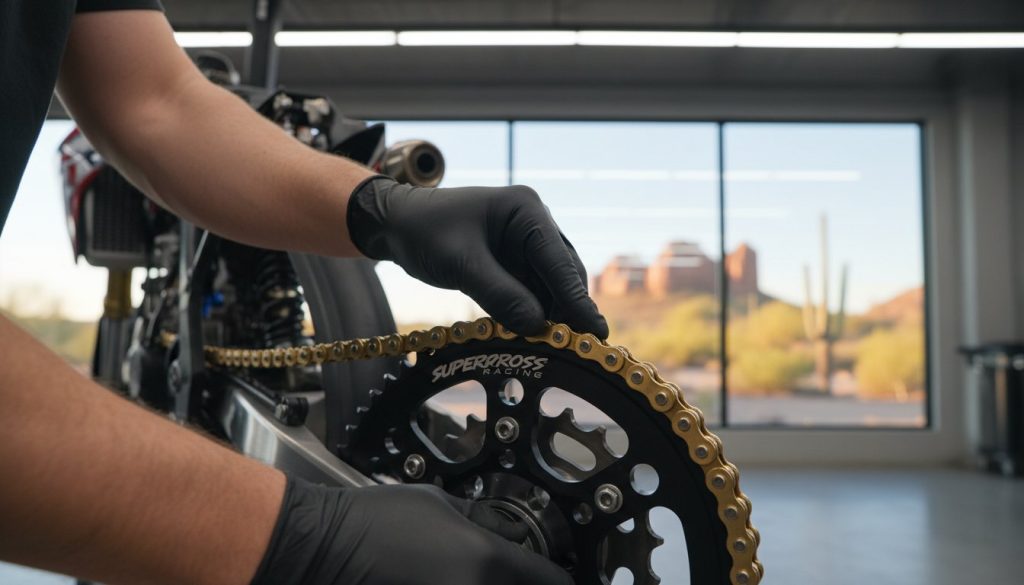
A drivetrain that fails before the 8,000 mile mark isn’t just a maintenance oversight; it’s a symptom of mismatched mechanical specifications. Many riders accept rapid wear and inconsistent power delivery as a standard tax on performance, often struggling with the accelerated degradation of entry-level components. Selecting the correct motorcycle chain sprocket configuration requires more than just matching a make and model. It demands a professional understanding of how tensile strength and material hardness dictate the longevity of your machine’s secondary drive.
You can achieve a drivetrain lifespan exceeding 20,000 miles while simultaneously reducing unsprung weight and refining power delivery. This guide clarifies the technical nuances between 520, 525, and 530 chain pitches to eliminate common installation errors. We evaluate the operational trade-offs between 7075-T6 aluminum and high-carbon steel to ensure your hardware matches your specific torque requirements. This analysis provides the engineering insights needed to optimize your motorcycle’s efficiency and durability through precise component integration.
Key Takeaways
- Optimize the final stage of power transmission by understanding the mechanical relationship between the front and rear motorcycle chain sprocket components.
- Evaluate the trade-offs between rotational mass and abrasive wear resistance by analyzing the engineering properties of C45 carbon steel versus 7075-T6 aluminum.
- Discover how a 520 conversion utilizes pitch down-sizing to reduce rotational inertia, facilitating faster engine acceleration and improved throttle response.
- Implement a selection framework that aligns drivetrain pitch and chain tensile strength with your specific engine torque output and riding environment.
- Leverage precision-engineered Superlite drivetrain solutions and integrated kits to ensure maximum component compatibility and system longevity.
The Critical Role of the Motorcycle Chain and Sprocket System
The drivetrain serves as the final stage of power transmission within a motorcycle’s mechanical architecture. It functions by transferring rotational energy from the engine countershaft directly to the rear wheel assembly. This motorcycle chain and sprocket system relies on a precise mechanical relationship between the drive sprocket, often called the front or countershaft sprocket, and the driven sprocket located at the rear hub. As the engine rotates the drive sprocket, the chain’s rollers engage the sprocket teeth to pull the rear wheel into motion.
Understanding Chain Pitch and Sprocket Compatibility
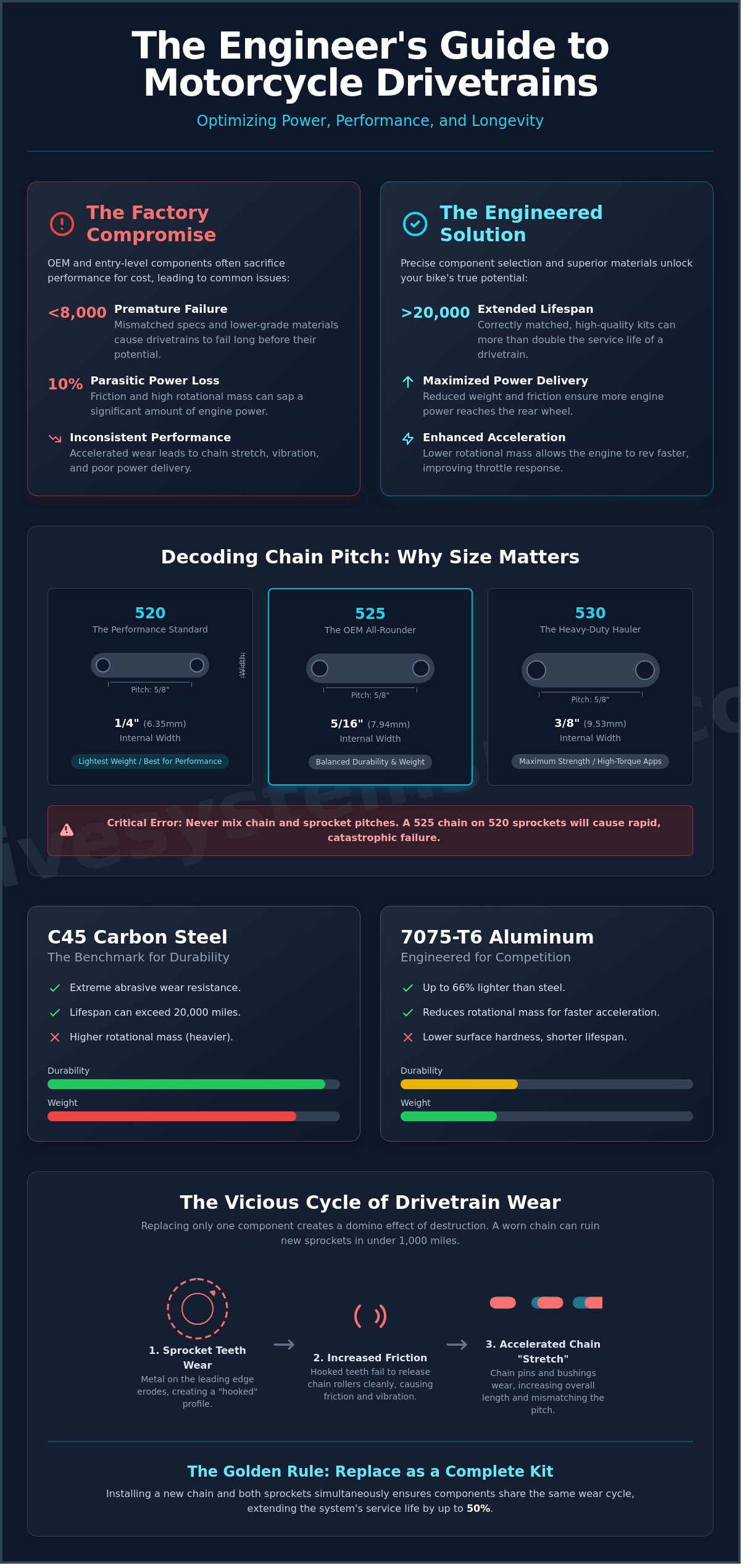
Chain pitch standards such as 420, 520, 525, and 530 define the physical dimensions of the drivetrain components. These numbers represent specific measurements. The first digit indicates the pitch, which is the distance between the centers of the chain pins in eighths of an inch. A 500-series chain has a 5/8-inch pitch. The subsequent two digits represent the internal width of the chain in eightieths of an inch. A 530 chain measures 3/8 inches wide, whereas a 520 chain is 1/4 inch wide.
Mixing these pitches is a critical error that leads to immediate mechanical failure. Installing a 525 chain on 520 sprockets creates excessive lateral play. This movement causes the chain to walk across the teeth, generating heat and rapid wear. Drivetrain efficiency depends on the precise interface of the roller diameter and the inner plate width against the sprocket face. When these dimensions don’t align, the system loses its ability to transfer torque smoothly.
The Impact of Drivetrain Wear on Performance
Drivetrain degradation often manifests as ‘hooking’ on the sprocket teeth. This occurs when the metal on the leading edge of the tooth wears away, creating a curved, hook-like profile. These deformed teeth no longer release the chain rollers cleanly, which increases friction and vibration. Worn sprockets accelerate chain stretch. While the metal plates don’t physically stretch, the pins and bushings wear down, increasing the overall length of the chain and throwing it out of sync with the sprocket pitch.
This creates a vicious cycle. A worn chain will ruin the profile of a brand-new sprocket in fewer than 1,000 miles of operation. To maintain mechanical integrity and maximize longevity, technicians must replace the entire kit simultaneously. Installing a complete motorcycle chain sprocket set ensures that all components share the same wear cycle. This practice can extend the service life of the system by 50% compared to replacing components individually.
Material Engineering: Comparing Steel and Aluminum Sprockets
Selecting a motorcycle chain sprocket requires a technical evaluation of material properties against specific operational demands. C45 carbon steel serves as the benchmark for tensile strength and surface hardness. It withstands the constant abrasive forces of the drive chain for 20,000 miles or more in standard street applications. Conversely, 7075-T6 aluminum alloy is engineered for competition. While it matches the tensile strength of some mid-grade steels at approximately 572 MPa, its primary advantage is the 66% reduction in density compared to iron-based alloys.
The core tradeoff involves rotational mass versus abrasive wear resistance. A lighter sprocket reduces the moment of inertia, allowing the engine to transfer power to the rear wheel with less parasitic loss. This results in measurable gains in acceleration. However, aluminum’s lower surface hardness leads to faster tooth profile degradation under high-torque loads. To mitigate this, premium steel sprockets often undergo induction hardening. This process uses electromagnetic induction to heat the teeth specifically, reaching a Rockwell hardness of 45-50 HRC while maintaining a ductile core to prevent brittle fracture.
Steel Sprockets: The Standard for Longevity
High-carbon steel is the definitive choice for high-mileage touring and daily commuting where reliability is the priority. Quality manufacturers utilize laser-cutting technology rather than traditional stamping. Laser-cutting maintains a precision tooth profile within 0.02mm tolerances, ensuring uniform load distribution across the chain rollers. While steel is heavier, “lightened” designs use computer-aided design (CAD) to remove non-structural material from the sprocket face. These windows reduce weight by up to 20% without compromising the component’s structural integrity. Rigorous chain and sprocket maintenance is still required to maximize the 30,000-mile potential of these hardened steel components.
Aluminum Sprockets: Maximizing Racing Performance
Aluminum sprockets focus on the reduction of unsprung weight. Lowering unsprung mass improves suspension response because the shock absorber can control the wheel’s movement more effectively over irregularities. To extend the service life of these softer alloys, a hard-anodized coating (MIL-A-8625 Type III) is applied. This electrochemical process creates a ceramic-like surface layer that resists galling. You should exercise caution when fitting aluminum sprockets to 1000cc liter bikes. The massive torque output of these engines can deform aluminum teeth in fewer than 5,000 miles if the chain isn’t perfectly aligned and lubricated. Engineers at Drive Systems USA suggest aluminum primarily for closed-course racing where every fraction of a second matters.
- Street Riding: C45 Steel or Induction Hardened Steel for maximum service life.
- Track/Racing: 7075-T6 Aluminum to minimize rotational inertia and improve flickability.
The 520 Conversion: Unlocking Performance Through Weight Reduction
A 520 conversion involves replacing the factory-installed 525 or 530 drivetrain with a narrower 520 pitch system. This modification targets the reduction of unsprung and rotational mass within the motorcycle chain sprocket assembly. By decreasing the physical dimensions of the components, riders minimize rotational inertia. This allows the engine to transfer power to the rear wheel more efficiently. It results in faster throttle response and quicker acceleration because the engine spends less energy spinning the drivetrain hardware. Many riders notice that the bike feels more alive, as the reduction in mass allows the RPMs to climb with less mechanical resistance.
High-tensile chains from manufacturers like D.I.D. and EK have effectively debunked the theory that narrower chains lack the strength for high-displacement engines. These components are engineered using sophisticated metallurgical techniques to handle the torque of modern liter-bikes. For instance, a scientific study on motorcycle chain engineering highlights how advanced heat treatment and material microstructure optimization allow modern chains to maintain structural integrity under extreme loads. A standard conversion kit typically removes between 1.5 and 3 lbs of weight from the drivetrain, which is a significant reduction for a system that spins at thousands of revolutions per minute.
Is a 520 Conversion Right for the Street?
Street riders often hesitate to down-size due to longevity concerns. While a 530 chain provides more surface area for lubricant, modern high-tensile options like the D.I.D. ZVM-X or EK ZVX3 offer tensile strengths exceeding 10,000 lbs. This capacity makes them entirely suitable for modern 1000cc street bikes. Maintenance must remain a priority. Cleaning and lubricating the system every 500 miles ensures the seals remain functional. The cost-per-mile is slightly higher because a 520 system might wear 20% faster than a heavier 530 setup. For many, the performance gain justifies the shorter service interval. It’s a calculated trade-off where durability is traded for a more responsive machine.
Calculating the Performance Gains
Reducing rotational mass yields exponential benefits compared to static weight. In motorcycle dynamics, 1 lb of rotational mass reduction is roughly equivalent to 7 lbs of static weight reduction during acceleration. This shift significantly alters the gyroscopic effect of the drivetrain. The bike becomes more responsive during rapid transitions. It improves flickability in technical sections because there’s less centrifugal force resisting changes in direction. Utilizing Superlite 520 steel sprockets provides a unique advantage. These components are precision-machined to offer a weight profile similar to aluminum while maintaining the 30,000-mile durability of steel. This creates a balanced motorcycle chain sprocket configuration that prioritizes both speed and mechanical integrity without the rapid wear associated with alloy sprockets.
Drivetrain Selection Framework: Matching Pitch and Gearing to Your Application
Gearing Theory: Speed vs. Torque
Final drive ratios are determined by the relationship between front and rear sprocket tooth counts. Reducing the front sprocket by one tooth or increasing the rear by two, known as the -1/+2 standard, shortens the gearing. This modification increases torque at the rear wheel for faster acceleration but reduces top speed. It also impacts speedometer accuracy, often resulting in a 7% to 12% error in factory readings. Fuel economy typically drops by 5% due to higher cruising RPMs. Choose taller gearing for highway efficiency and shorter gearing for technical circuits or off-road climbs. For a deeper technical breakdown of how moto sprocket geometry and gear ratios affect engine stress and drivetrain longevity, reviewing the engineering principles behind tooth count selection is essential before making any modifications.
Selecting the Right Chain Brand and Model
Professional series chains from D.I.D. and EK Enuma represent the industry standard for precision engineering. The D.I.D. ZVM-X series utilizes a patented X-Ring design that reduces friction by 40% compared to traditional O-Ring seals. This design traps lubricant more effectively, extending service life by 50% in harsh conditions. For high-performance 1000cc+ machines, the EK ZVX3 series offers a tensile strength exceeding 11,000 lbs. A 520 conversion can save between 1.5 and 2.2 lbs of rotating mass, though it’s only recommended for riders who prioritize flickability over long-term durability.
Precision components ensure your drivetrain operates at peak efficiency under extreme mechanical stress. For expert guidance on drivetrain integration, contact Drive Systems USA to source engineered solutions for your specific application.
Drive Systems USA: Precision-Engineered Superlite Drivetrain Solutions
Drive Systems USA functions as a specialized engineering partner for riders who demand industrial-grade reliability. Their Superlite sprockets are recognized as the industry leader in high-strength, lightweight steel designs, offering a weight reduction of up to 25 percent compared to standard steel alternatives without compromising structural rigidity. The manufacturing process relies on CNC machining and aerospace-grade alloys to maintain concentricity within microns. Because the company acts as an authorized distributor for D.I.D. and EK, they provide authentic, top-tier quality that prevents the premature failure associated with counterfeit or budget-grade hardware. This status ensures that every motorcycle chain sprocket kit consists of components designed to work in perfect synchronization.
The Superlite Advantage: Induction Hardening and Precision Fit
Mechanical longevity depends on surface integrity. Superlite sprockets utilize a specialized induction hardening process to achieve superior abrasive resistance. This thermal treatment targets the teeth specifically, leaving the core resilient enough to handle high torque loads without becoming brittle. The proprietary tooth profile is engineered to optimize chain engagement, which significantly reduces mechanical noise and vibration during high-speed operation. These design choices result in a drivetrain that runs smoother and lasts longer under harsh conditions. Drive Systems USA maintains an extensive inventory of custom-tailored kits, providing specific configurations for nearly every modern motorcycle model currently in production, from street-focused commuters to high-performance track machines. For riders involved in specialized competitive circuits, Fat Boy Design USA offers the precision components necessary for the unique demands of Bagger racing.
Why Buy a Complete Kit from Drive Systems USA?
Selecting individual components often leads to compatibility issues and accelerated wear. The Drive Systems USA ‘Integrated Kit’ philosophy solves this by bundling matched hardware into a single, cohesive unit. These kits arrive with a pre-cut chain and sprockets sized for a seamless ‘drop-in’ installation, removing the need for manual resizing or specialized shop tools. This precision ensures that the chain’s pitch perfectly matches the sprocket’s tooth profile from the first mile. Technical support is handled by a US-based team of drivetrain specialists who understand the nuances of gear ratios and pitch requirements. They provide the expertise needed to solve complex mechanical challenges for both amateur riders and professional racing teams. You’ll receive professional guidance that ensures your motorcycle chain sprocket system operates at peak efficiency. Optimize your ride today with a Superlite Sprocket and Chain Kit.
Optimizing Your Drivetrain for Maximum Mechanical Efficiency
Selecting the right motorcycle chain sprocket configuration isn’t just a matter of routine maintenance; it’s a critical engineering decision that dictates your machine’s power delivery and operational longevity. You’ve seen how material selection between induction-hardened steel and 7075-T6 aluminum directly affects unsprung weight. You also understand how a 520 conversion reduces rotating mass to improve throttle response. These mechanical optimizations require components built to exacting tolerances to ensure consistent performance under high-torque conditions. Precision is the difference between efficient power transfer and premature system failure.
Drive Systems USA has provided engineered drivetrain solutions for over 20 years. As an authorized distributor for industry leaders D.I.D. and EK Chain, we combine world-class manufacturing with our proprietary Superlite technology. This ensures every component meets rigorous standards for durability and mechanical fitment. Don’t settle for generic components when your drivetrain’s integrity is at stake. Our team applies two decades of technical expertise to help you achieve the perfect balance of weight and strength.
Build Your Custom Superlite Chain and Sprocket Kit to secure a high-performance setup tailored to your specific application. You’ll appreciate the increased efficiency and reliability that comes from a professionally engineered drivetrain on your next ride.
Frequently Asked Questions
How often should I replace my motorcycle chain and sprockets?
You should replace your motorcycle chain and sprocket components every 15,000 to 20,000 miles, depending on your maintenance habits and environmental conditions. While some high-performance setups require service at 10,000 miles, regular lubrication every 500 miles extends the assembly’s operational life—learn more about Rida Lubricants for insight into premium automotive and industrial lubricants that minimize friction on critical parts. We recommend replacing the chain and both sprockets as a matched set to prevent accelerated wear caused by old pitch patterns mating with new surfaces.
Can I use a 520 chain on a bike that came with a 530 pitch?
You can’t use a 520 chain on a 530 system without replacing both the front and rear sprockets to match the new width. The 520 designation indicates a 0.250-inch internal width, while a 530 pitch measures 0.375 inches. Attempting to mix these sizes results in immediate mechanical failure or chain derailment. A complete conversion kit ensures the 0.125-inch width difference is uniform across all drive components.
What is the difference between an O-ring and an X-ring chain?
The primary difference lies in the cross-section of the rubber seals located between the side plates. O-rings utilize a circular profile that creates two contact points; X-rings feature a four-lipped design. This X-shaped geometry reduces friction by 40% compared to standard O-rings and retains lubricant more effectively. Consequently, X-ring chains provide a 50% increase in wear life over traditional sealed designs.
Will a 520 conversion make my motorcycle faster?
A 520 conversion improves acceleration by reducing the rotating mass of the motorcycle chain sprocket system by approximately 1.5 to 2.5 pounds. This reduction in unsprung weight allows the engine to reach peak RPM more quickly. It doesn’t increase raw horsepower, but it optimizes the power-to-weight ratio for better throttle response. You’ll notice the most significant gains in 600cc to 1000cc sportbikes during corner exits.
Should I choose a steel or aluminum rear sprocket for my street bike?
Choose a high-carbon steel rear sprocket for street bikes to maximize durability and service life. Steel sprockets typically last 3 times longer than 7075-T6 aluminum alternatives under standard road conditions. While aluminum saves about 1 pound of weight, it wears rapidly when exposed to road grit. For riders prioritizing 20,000-mile reliability over marginal weight savings, steel is the engineered solution.
What does the ‘-1/+2’ gearing modification actually do?
The -1/+2 modification involves removing 1 tooth from the countershaft sprocket and adding 2 teeth to the rear sprocket. This change increases the final drive ratio, which provides roughly 10% to 15% more torque at the rear wheel. While it improves low-end acceleration, it reduces the theoretical top speed and increases engine RPM at highway cruising speeds. This specific configuration is a standard optimization for track days and urban environments.
Do I need special tools to install a new chain and sprocket kit?
You need a dedicated chain breaker and riveting tool to secure the master link properly. Most modern street bikes use 520, 525, or 530 chains that require a rivet-style connecting link for safety at high speeds. You’ll also need a torque wrench to tighten the sprocket nuts to the manufacturer’s specification, which often ranges from 60 to 100 lb-ft. Using pliers or hammers to join links compromises the structural integrity of the drive system.
How do I know if my sprockets are worn out?
Inspect the sprocket teeth for a “shark fin” profile or visible hooking where the metal has thinned on one side. If the teeth appear pointed rather than flat-topped, the component has reached its wear limit. You can also test for wear by pulling the chain away from the rear of the sprocket. If you can see more than 50% of a sprocket tooth, the pitch has elongated beyond the 1.5% allowable tolerance.