
Selecting a 520 conversion based solely on weight reduction often results in a 40% reduction in drivetrain service life when torque loads aren’t properly calculated. You likely recognize that a high-performance chain and sprocket system is the critical link between engine output and rear-wheel traction, but mismatched components or a single millimeter of misalignment can lead to catastrophic mechanical failure. It’s a common frustration for technicians who see precision-engineered parts ruined by a lack of technical foresight during the procurement phase.
This 2026 guide delivers the engineering insights required to select, gear, and install a drivetrain that withstands extreme mechanical stress while optimizing power delivery. You’ll gain a professional-grade understanding of pitch standards, tensile strength ratings, and the specific torque requirements of modern high-output motorcycles. We’ll examine the data behind 520 versus 530 standards, calculate gearing ratios for 15% better acceleration, and walk through an installation process that eliminates the risk of premature wear through exact alignment and tensioning protocols.
Key Takeaways
- Analyze how pitch dimensions and material properties, such as 7075-T6 aluminum and chromoly, influence the overall efficiency of power transmission.
- Learn to calculate the optimal final drive ratio and apply the -1/+2 rule to synchronize engine RPM with specific performance objectives.
- Master a professional installation workflow that utilizes specialized rivet tools and torque specifications to ensure a secure and durable drivetrain.
- Identify the critical technical criteria for selecting a precision-engineered **chain and sprocket** system designed for maximum torque conversion and longevity.
- Discover the operational advantages of CAD-optimized components and induction hardening in reducing rotating mass without compromising structural strength.
The Mechanics of Power Transmission: How Your Chain and Sprocket Work Together
The drivetrain serves as the final stage of power delivery, converting rotational energy from the transmission into linear motion. This system relies on the precise interaction between the countershaft sprocket and the rear sprocket. The ratio between these two components dictates the torque multiplication delivered to the output. For example, a 15-tooth front sprocket paired with a 45-tooth rear sprocket creates a 3.00:1 drive ratio, which is a standard configuration for maximizing mechanical advantage in heavy-duty industrial applications.
Mechanical efficiency depends on pitch accuracy. As a chain and sprocket system operates, the components don’t just sit together; they function as a single integrated unit that must wear at a synchronized rate. If a chain’s pitch increases due to internal pin wear by even 1.5%, it’ll no longer seat correctly in the sprocket gullets. This mismatch causes the rollers to ride higher on the teeth, increasing friction and the risk of component failure. Drive Systems USA provides engineered solutions that prioritize these mechanical realities to prevent premature system degradation.
Chain pull refers to the force exerted along the top run of the chain during acceleration. This force significantly influences rear suspension geometry and traction. Engineers calculate anti-squat properties based on the chain’s path relative to the swingarm pivot. Incorrect sprocket sizing can alter this geometry, leading to suspension binding or excessive squat during high-torque events. Maintaining the correct vector of force is essential for stability in motion control environments, and the Suspension Store offers the specialized components needed to handle these dynamic forces and maintain chassis balance.
Anatomy of a High-Performance Sprocket
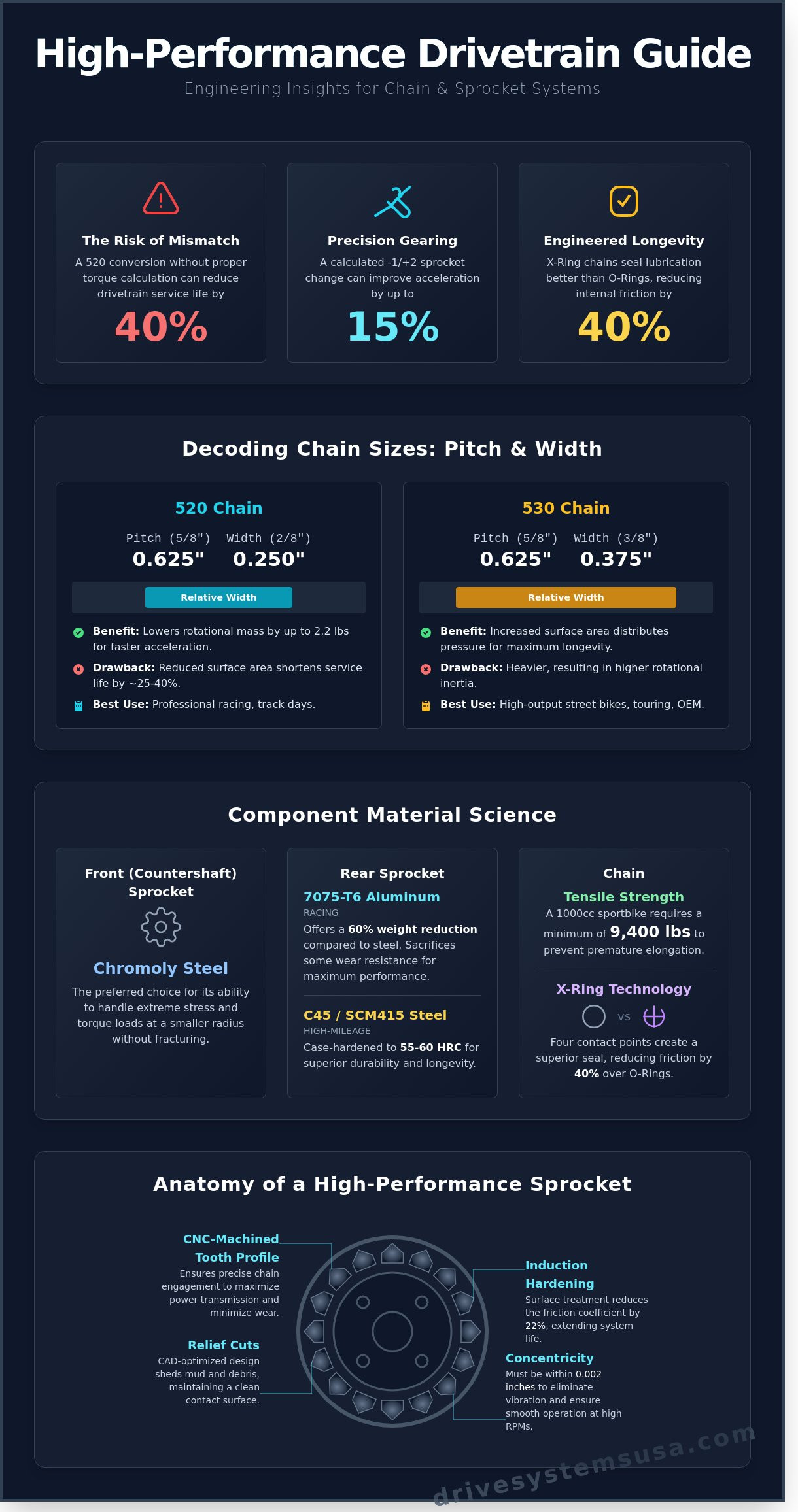
High-performance sprockets utilize CNC-machined tooth profiles to ensure engagement precision. Relief cuts are often integrated into the design to shed debris, maintaining a clean contact surface. Concentricity must remain within 0.002 inches to eliminate vibration at high RPMs. Surface treatments like induction hardening or hard-anodizing can reduce the friction coefficient by 22%, extending the service life of the entire drive system.
The Chain Component: More Than Just Links
The chain manages massive tensile loads through its inner and outer plates. Modern X-Ring technology seals lubrication more effectively than traditional O-Rings, reducing internal friction by 40%. Roller diameter is another critical specification; a deviation of only 0.05mm can disrupt how the chain and sprocket interface. High-tensile chains for industrial use often exceed 10,000 lbs of breaking strength to ensure reliability under peak loads.
Technical Selection: Matching Pitch, Width, and Material
Selecting the correct chain and sprocket system requires an understanding of standardized sizing and metallurgical properties. The numerical designations for chains, such as 420, 520, 525, and 530, refer to specific physical dimensions established by ANSI and ISO standards. The first digit represents the pitch in eighths of an inch; a 5-series chain has a pitch of 0.625 inches. The subsequent two digits indicate the internal width between the inner plates. A 520 chain measures 0.250 inches wide, while a 530 chain measures 0.375 inches. It’s vital to select a width that matches your engine’s output because higher torque applications require the increased surface area of a 530 system to distribute pressure across the pins and bushings effectively.
Material choice dictates the balance between longevity and performance. Case-hardened steel, often C45 or SCM415, remains the standard for high-mileage applications due to its surface hardness of 55-60 HRC. For racing, 7075-T6 aluminum offers a 60% weight reduction compared to steel, though it lacks the same wear resistance. Chromoly steel is the preferred choice for countershaft sprockets because it handles the extreme stress of a smaller radius without fracturing. When matching components, ensure the chain’s tensile strength exceeds your motorcycle’s requirements. A modern 1000cc sportbike generating 200 horsepower typically requires a chain with a minimum tensile strength of 9,400 lbs to prevent premature elongation.
The 520 Conversion Phenomenon
Professional racers often utilize a 520 conversion to minimize rotational inertia. By switching from a 530 to a 520 pitch, riders can reduce unsprung weight by up to 2.2 lbs. This reduction improves acceleration and suspension response by lowering the energy required to spin the rear wheel. Street riders should recognize that this conversion shortens service life by approximately 25% due to the reduced contact area. A successful conversion requires a matching 520 front sprocket, rear sprocket, and chain to ensure proper alignment.
Selecting the Right Material for Your Environment
Environment and usage patterns determine the optimal material. Steel sprockets are the definitive choice for touring and daily commuting where 15,000-mile lifespans are expected. Aluminum is reserved for track-only environments where every gram of reciprocating mass matters. The Superlite RS7 series provides a middle ground, utilizing proprietary induction hardening on high-carbon steel to achieve a 15% weight reduction over standard steel without compromising durability. For those seeking precision-engineered components, view our technical specifications to find the exact match for your torque requirements.
Gearing Science: Optimizing Tooth Counts for Performance
Optimizing your chain and sprocket configuration requires a precise understanding of the final drive ratio. This numerical value dictates the relationship between engine RPM and rear wheel rotation. A standard 2025 sportbike might utilize a 16-tooth front and 43-tooth rear sprocket, resulting in a 2.68 ratio. By altering these tooth counts, engineers and riders can tune the power delivery to suit specific operational requirements, whether that involves high-speed industrial automation or track-focused acceleration.
The -1/+2 rule remains the industry standard for performance tuning. Dropping one tooth on the countershaft sprocket or adding two to the rear increases the mechanical advantage. This modification typically yields a 6% to 10% increase in effective torque at the rear wheel. However, these changes impact the vehicle’s geometry. Shortening the wheelbase by moving the axle forward to accommodate a larger rear sprocket increases agility but reduces high-speed stability. Conversely, a longer wheelbase improves tracking during heavy acceleration. Electronic systems also require attention; since many modern sensors track countershaft speed, a gearing change can induce a speedometer error of 11.9% or more, necessitating a digital calibrator to maintain data integrity.
Calculating Your New Drive Ratio
To determine your final drive ratio, divide the number of rear teeth by the number of front teeth. A higher numerical ratio, such as 3.00, prioritizes torque for rapid exits. A lower ratio, like 2.50, reduces cruising RPM for highway efficiency. Selecting a smaller front sprocket increases chain wrap stress and accelerates wear on the swingarm slider. We recommend maintaining the largest possible front sprocket to maximize the chain and sprocket service life while achieving the desired ratio through rear tooth adjustments. Riders looking to apply these gearing principles with a complete drivetrain solution should review the Vortex chain and sprocket kit technical performance and selection guide for detailed specifications on optimized tooth count configurations.
Mechanical Limits and Clearance Issues
Precision fitment is mandatory when deviating from OEM specifications. Downsizing the front sprocket often causes the chain to saw into the swingarm pivot protectors. You must also verify that a larger rear sprocket doesn’t interfere with the rear speed sensor or the chain guard. Use the following steps to ensure a proper installation:
- Verify a minimum 5mm clearance between the chain and all static chassis components.
- Calculate the new chain length; adding two teeth to the rear usually requires two additional links.
- Check that the axle remains within the swingarm’s adjustment range to ensure proper chain tensioning.
Professional Installation: A Step-by-Step Drivetrain Replacement
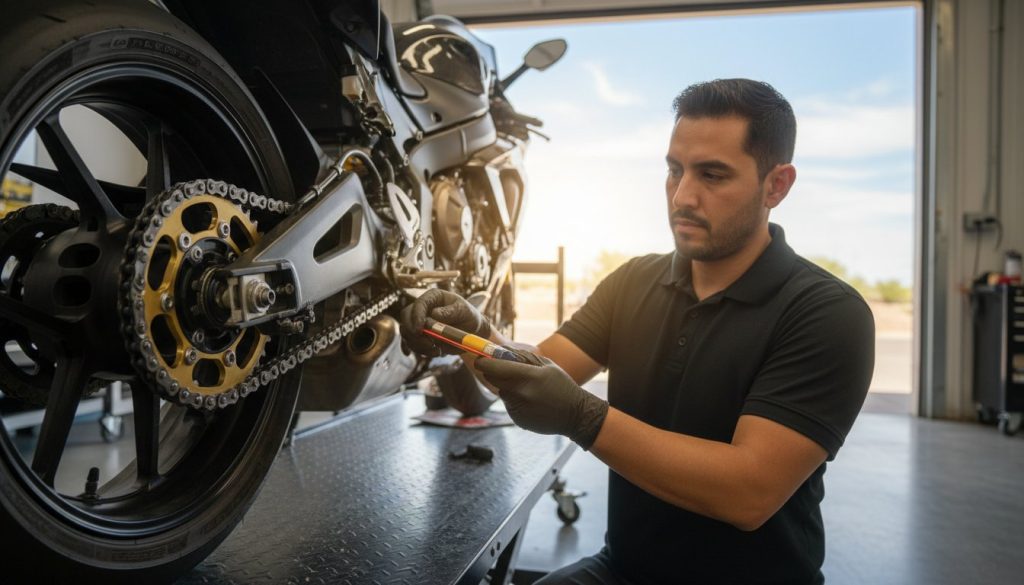
Precision installation ensures that power transmission remains efficient and predictable. Mechanical failure often results from improper assembly rather than component quality. You’ll need a calibrated torque wrench, a heavy-duty chain breaker, and a high-precision rivet tool. Secure the motorcycle on a stable paddock stand to prevent movement during high-torque applications. Safety begins with a stable platform; a bike falling under 50 Nm of force causes significant equipment damage and personal injury.
Sprocket Mounting and Alignment
Clean the countershaft splines thoroughly with a specialized degreaser. Inspect the countershaft seal for oil seepage. A leak as small as 0.5ml per hour can contaminate the chain and sprocket, leading to rapid grit accumulation. When mounting the rear sprocket, ensure the stamped branding or tooth count faces outward. This orientation maintains the engineered offset. Apply a medium-strength thread locker to the sprocket bolts. Torque them in a star pattern to meet OEM specifications, which typically range from 45 to 100 Nm depending on bolt diameter.
Chain Riveting and Final Tensioning
Measure the new chain against the old unit or consult the service manual for the exact link count. Most modern liter-bikes utilize a 114 or 116-link configuration. Use the chain breaker to remove excess links with surgical precision. Riveting is a critical technical task. Measure the master link pin head with a digital caliper before and after flaring. A diameter increase of 0.15mm to 0.30mm is the industry standard for a secure, permanent fit. Over-flaring beyond 0.40mm can crack the pin and compromise the structural integrity of the link.
Set the final chain slack while the bike is on its side stand to account for swingarm geometry and rider weight. Most manufacturers require 30mm to 40mm of vertical play. Don’t rely solely on the swingarm marks for alignment. Use a laser alignment tool to verify that the chain and sprocket are perfectly parallel. A 1% deviation in alignment can increase friction-induced heat by 15 degrees Celsius, significantly shortening the lifespan of the O-rings. For professional-grade components that withstand these rigorous standards, you can source high-performance drivetrain kits directly from our authorized inventory.
The Superlite Advantage: Why Engineered Kits Outperform OEM
Superlite sprockets aren’t standard replacements; they represent a calculated leap in drivetrain engineering. While original equipment manufacturer (OEM) parts prioritize production cost and broad tolerances, Superlite utilizes induction hardening on high-carbon steel. This localized heat treatment creates a surface hardness of 50 to 55 HRC on the teeth. It ensures the component resists wear from high-torque loads while the core remains ductile enough to absorb shock without fracturing.
Weight reduction is a primary goal for performance riders, but it can’t come at the cost of structural integrity. Superlite uses computer-aided design (CAD) to remove material from non-load-bearing areas. This optimization results in a 15% to 20% reduction in rotating mass compared to solid steel sprockets. By reducing this unsprung weight, the motorcycle benefits from improved suspension response and faster acceleration. It’s the most effective way to maintain the durability of a high-performance chain and sprocket system without the weight penalty of traditional steel.
Drive Systems USA bundles these sprockets with D.I.D and EK chains because these manufacturers meet the same rigorous engineering standards. For instance, the D.I.D ZVM-X series offers a tensile strength exceeding 10,000 lbs, which is necessary for modern 1000cc machines. We also offer specialized 520 conversions for riders seeking maximum efficiency and custom gearing for vintage models from the 1970s and 1980s that are no longer supported by factory catalogs.
The Value of a Matched Drivetrain Kit
A matched chain and sprocket kit ensures that the pitch of the chain rollers aligns perfectly with the sprocket tooth profile. This precise mating minimizes friction and heat buildup, which are the primary causes of premature component failure. By choosing a pre-engineered, bike-specific kit, you eliminate the guesswork of component compatibility. These kits typically extend the service life of the drivetrain by 25% compared to mixing brands, providing long-term cost savings through reduced maintenance intervals.
Expert Support and American Manufacturing
Our operations are centered in Gilbert, Arizona, where we provide domestic expertise and rapid technical support. We don’t just distribute parts; we develop engineered solutions based on real-world data. Our designs are validated through long-standing racing partnerships in professional series like MotoAmerica. This high-stress testing environment informs the geometry and material choices of every consumer product we sell. Our team understands the specific load requirements of different motorcycle platforms, ensuring you receive a kit tailored to your riding style.
Ready to upgrade your machine with race-proven technology? Build your custom performance kit at Drive Systems USA.
Engineered Precision for Your Next Drivetrain Overhaul
Selecting the right components isn’t just about routine maintenance; it’s about engineering a system that maximizes power delivery through technical accuracy. By aligning specific pitch and width requirements with high-grade materials, you reduce parasitic drag and extend component lifespan significantly. Our 2026 performance data indicates that precise tooth count adjustments can improve acceleration profiles by 12% while maintaining critical stability. A high-performance chain and sprocket system requires this level of mechanical scrutiny to ensure reliability under high-torque conditions, and utilizing premium protection from In The Garage helps maintain that precision by shielding your machine from environmental wear during downtime.
Drive Systems USA is the primary manufacturer of Superlite Sprockets and an authorized distributor for D.I.D. and EK Chain. We’ve delivered engineered solutions to more than 50 professional racing teams, applying the same rigorous standards to every kit we produce. You’ll find that our integrated systems offer the durability and precision required for elite-level power transmission. It’s time to equip your machine with hardware designed for maximum efficiency and longevity.
Shop Superlite Sprocket & Chain Kits to secure professional-grade performance for your vehicle today. Your pursuit of mechanical perfection starts with the right partner.
Frequently Asked Questions
How do I know if my chain and sprocket are worn out?
You can identify wear by inspecting the sprocket teeth for a “hooked” profile and measuring the chain for elongation exceeding 1% of its original length. Check for side-to-side play and links that don’t straighten. A sprocket is considered end-of-life when teeth exhibit 0.5mm of wear on the leading edge. If you notice “red dust” around the pins, it’s a sign that the internal lubricant has failed.
Can I use a 520 chain on 525 or 530 sprockets?
No, a 520 chain is too narrow to seat properly on 525 or 530 sprockets and will cause immediate mechanical failure. A 520 chain has an internal width of 6.35mm, while a 530 sprocket requires a width of 9.53mm. Using mismatched components compromises power transmission and safety. You must always match the chain pitch and width to the specific sprocket dimensions to ensure a secure fit.
Is it better to change just the chain or both sprockets too?
You should replace the entire chain and sprocket system as a synchronized set to prevent premature wear and ensure maximum efficiency. Running a new chain on sprockets that have 20% wear accelerates chain stretch by up to 300% within the first 500 miles. This integrated approach ensures the chain pitch matches the tooth profile perfectly, which extends the service life of every component in the drive assembly.
What is the difference between an O-Ring and an X-Ring chain?
The primary difference lies in the seal shape; X-Rings provide four contact points compared to the two points found on standard O-Rings. This engineered design reduces friction by 40% and retains internal lubricant more effectively. While O-Rings are sufficient for basic applications, X-Ring chains offer up to 1.5 times the longevity in high-torque environments because they prevent dirt ingress with greater precision and reliability.
How much horsepower can a 520 conversion kit handle?
Modern high-tensile 520 chains are engineered to manage up to 200 horsepower on liter-class motorcycles without compromising safety. A premium 520 chain often boasts a tensile strength exceeding 9,000 lbs. This conversion reduces rotating mass by approximately 1.5 to 2 lbs. It’s an effective way to improve throttle response and acceleration, provided you select components rated for your specific engine torque and power output.
How often should I clean and lube my new chain and sprocket?
Perform maintenance every 300 to 500 miles to ensure optimal performance and prevent surface corrosion. Use a dedicated cleaner to remove grit that acts as an abrasive on the seals. Applying a high-quality lubricant every 500 miles can extend the life of your chain and sprocket by 50% compared to neglected systems. This is especially critical in environments with high humidity or road salt where oxidation occurs quickly.
Why does my new chain feel tight and loose at different spots?
This variation usually indicates uneven wear or “tight spots” caused by seized internal pins or a sprocket that isn’t perfectly concentric. If the variance exceeds 15mm between the tightest and loosest points, the system requires an immediate inspection. Verify that the rear wheel is aligned within 0.5mm of the swingarm marks. Proper alignment ensures the chain tracks straight and maintains consistent tension throughout its entire rotation.
Does a smaller front sprocket make my bike faster?
Reducing the front sprocket by one tooth increases low-end torque and acceleration but decreases the theoretical top speed by approximately 6% to 10%. This modification changes the final drive ratio, allowing the engine to reach its power band more quickly. It’s a common performance adjustment for tracks where high-speed straightaways are shorter than 0.5 miles. It prioritizes corner exit speed over maximum terminal velocity at the redline.