
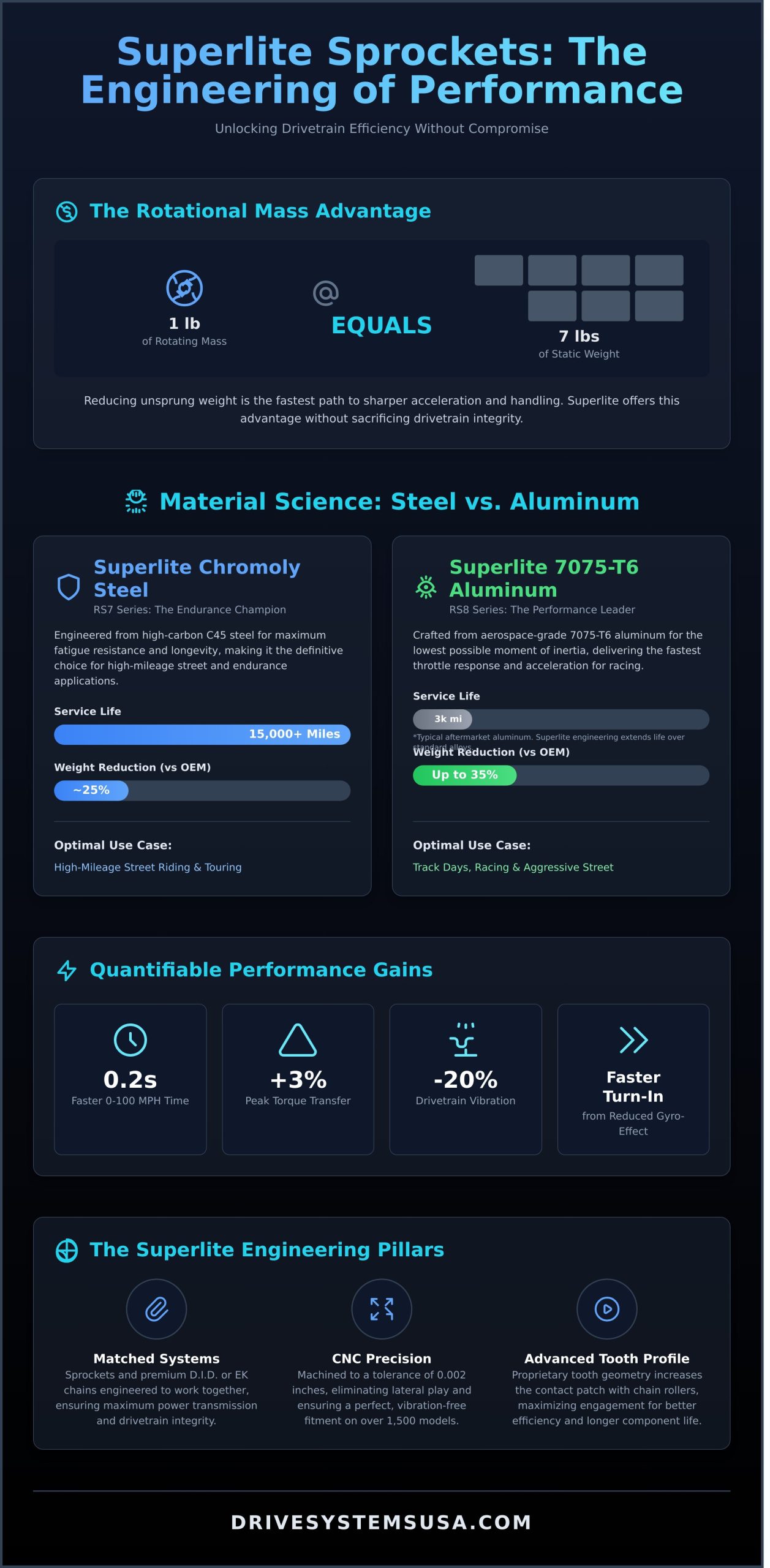
Removing a single pound of rotating mass from your drivetrain yields a performance advantage equivalent to stripping 7 pounds of static chassis weight. Most riders understand that reducing unsprung weight is the fastest path to sharper acceleration, yet they often hesitate to move away from heavy OEM steel due to the rapid 3,000 mile wear rates seen in many aftermarket aluminum alternatives. You shouldn’t have to choose between mechanical integrity and rotational efficiency.
It’s a common frustration when a 520 conversion delivers immediate throttle response but fails before the next service interval. By integrating high-carbon steel with precision-engineered weight reduction patterns, Superlite sprockets provide the industry’s most effective solution for torque efficiency and long-term durability. You’ll discover how these components maintain structural rigidity across 15,000 miles of operation while offering the weight profile of a dedicated racing part. This guide examines the specific metallurgical standards and CNC tolerances that allow for a 25 percent reduction in mass without compromising the drivetrain’s service life.
Key Takeaways
-
Learn how advanced tooth profiling and optimized strength-to-weight ratios establish Superlite sprockets as the definitive choice for high-performance drivetrain reliability.
-
Evaluate the mechanical advantages of high-carbon Chromoly steel versus 7075-T6 aluminum to determine the ideal metallurgy for your specific application.
-
Understand the technical impact of a 520 conversion on reducing rotating mass and unsprung weight to significantly improve acceleration efficiency.
-
Identify the optimal gearing configurations, such as the -1/+2 setup, to enhance low-end torque based on your annual mileage and performance requirements.
-
Discover why integrating sprockets with premium chains as a matched system is critical for ensuring long-term drivetrain integrity.
Table of Contents
-
What are Superlite Sprockets and Why Do They Lead the Market?
-
Selecting the Right Superlite Sprocket for Your Riding Style
What are Superlite Sprockets and Why Do They Lead the Market?
Superlite sprockets represent the pinnacle of drivetrain engineering, designed specifically to meet the rigorous demands of professional racing and high-performance street motorcycles. To understand their value, one must first grasp What are sprockets and how they function as the critical link in power transmission. Unlike standard components, these are engineered with a focus on reducing unsprung weight without compromising structural integrity. This is achieved through proprietary tooth profiling that ensures maximum chain engagement and longevity. It’s not just about changing a part; it’s about optimizing the entire kinetic chain of the vehicle.
Generic aftermarket parts often rely on universal templates that lead to suboptimal fitment and increased mechanical noise. Superlite differentiates itself through precision CNC machining to tolerances within 0.002 inches. This level of accuracy ensures that the sprocket sits perfectly flush against the hub, eliminating the lateral play that often plagues cheaper alternatives.
The product architecture is categorized into three distinct tiers to serve specific operational needs. The RSX series utilizes high-carbon C45 steel, providing a 15-25% weight reduction over OEM parts while maintaining extreme durability for high-mileage street use. For those seeking maximum weight savings, the RSX-R series features 7075-T6 aerospace-grade aluminum, often reducing mass by up to 35%. Hybrid options represent the third category, utilizing a steel outer ring for wear resistance bonded to an aluminum carrier for weight reduction. This multi-material approach provides the best of both worlds for endurance racing environments.
The Evolution of the Superlite Brand
Drive Systems USA has focused on drivetrain optimization since 2005. The brand’s commitment to innovation led to partnerships with Supercross, MotoAmerica and Isle of Man TT teams where failure isn’t an option. These high-torque environments served as the testing ground for the technology now available to consumers. The evolution of Superlite sprockets from track-only components to consumer kits was finalized in 2010, allowing street riders to access hardware capable of handling 200+ horsepower without premature deformation.
Key Performance Indicators (KPIs) of a Performance Sprocket
Performance metrics for Superlite sprockets center on three technical pillars:
-
Rotating Mass: Reducing the weight of the rear sprocket by 500 grams can significantly decrease gyroscopic forces, leading to faster turn-in and improved suspension response.
-
Torque Transfer: Precise tooth geometry increases the contact patch between the chain rollers and the sprocket, improving efficiency by 3% during peak acceleration.
-
Vibration Dampening: Strict machining standards eliminate eccentricities, which reduces chain "whip" and results in a 20% reduction in secondary vibration through the footpegs.
These KPIs aren’t just theoretical. In closed-circuit testing, the reduction in rotational inertia provided by a Superlite kit has been shown to shave 0.2 seconds off 0-100 mph sprint times compared to heavy, cast-iron OEM setups. It’s a calculated engineering solution for riders who prioritize mechanical efficiency and predictable power delivery.
Material Science: Chromoly Steel vs. 7075-T6 Aluminum
Metallurgy dictates the operational limits of every drivetrain component. For high-performance motorcycles, the choice of sprocket material isn’t a matter of preference; it’s a calculated engineering decision based on torque loads and rotational mass. Superlite sprockets are manufactured using two distinct alloys to meet specific mechanical requirements. Choosing the wrong material leads to accelerated wear, increased friction, and potential drivetrain failure under high stress. The physics of power transmission require a balance between the material’s yield strength and its density.
The technical debate regarding Chromoly Steel vs. 7075-T6 Aluminum centers on the strength-to-weight ratio. High-carbon Chromoly steel provides the highest fatigue resistance for long-term use. Conversely, 7075-T6 aluminum offers the lowest moment of inertia, which directly correlates to faster throttle response. Superlite engineers these parts to ensure that regardless of the material, the tooth profile remains stable throughout the part’s service life.
RSX Series Steel Sprockets: The Durability King
The RSX series utilizes SCM415 high-carbon Chromoly steel. This alloy is preferred for high-horsepower street bikes and long-distance touring where reliability is the primary metric. These sprockets handle the 150+ horsepower loads found in modern liter-bikes without sacrificing longevity. Each sprocket undergoes an induction-hardening process. This creates a hardened layer 0.5mm to 1.0mm deep on the teeth, providing maximum resistance to chain friction. To combat environmental degradation, the RS7 features a black zinc plating that meets 96-hour salt spray resistance standards, ensuring the component remains corrosion-free in all weather conditions.
RSX-R Hard Anodized Aluminum Sprockets: The Racer’s Choice
For competition use, the RSX-R Series prioritizes weight reduction. These components are up to 70% lighter than OEM steel alternatives. Superlite uses 7075-T6 aerospace-grade aluminum along with a military grade hard anodized finish which boasts a tensile strength of approximately 74,000 psi. This is significantly higher than the 6061 aluminum often used in lower-tier parts. To mitigate the natural softness of aluminum, these sprockets receive a Type III hard-anodized coating. This electrochemical process increases the surface hardness to 60-70 Rockwell C, effectively rivaling the surface durability of steel. Off-road variants also include self-cleaning mud grooves. These machined recesses allow debris to escape the tooth valleys, preventing chain tension spikes during motocross or enduro use.
Heat treatment is the final safeguard against "hooking," which occurs when sprocket teeth deform into a curved shape under load. This deformation ruins the chain’s pitch and creates a dangerous mechanical mismatch. By utilizing precise thermal cycles, Superlite ensures the core of the sprocket remains ductile enough to absorb shock while the surface stays hard enough to resist abrasive wear. If you’re unsure which material fits your specific torque requirements, you can consult our technical specifications to find the optimal configuration for your machine.
Precision machining ensures that every tooth profile is identical. This consistency reduces vibration and noise, which are common symptoms of poorly manufactured drivetrain parts. Whether selecting steel for its 20,000-mile service life or aluminum for its 0.5-pound weight savings, the material science behind Superlite sprockets provides a predictable, high-performance solution for any riding application.
Maximizing Acceleration with a 520 Conversion Kit
A 520 conversion represents the most effective method for reducing parasitic power loss within a motorcycle’s drivetrain. By replacing the standard 525 or 530 pitch components with narrower 520 hardware, riders achieve a measurable reduction in both unsprung weight and rotating mass. This modification isn’t just about static weight; it’s about the physics of rotational inertia. A standard 530 O-ring chain often weighs upwards of 5.1 lbs per 100 links, while a performance-oriented 520 chain like the D.I.D ZVM-X reduces that figure to approximately 3.6 lbs. When you integrate these chains with Superlite sprockets, the total system mass can drop by 2.5 lbs or more compared to OEM steel setups.
The safety concerns regarding 520 conversions on the street are largely based on outdated metallurgy from the 1990s. Modern 520 chains utilize advanced alloys and heat-treatment processes that provide a tensile strength of 8,745 lbs, which is more than sufficient for high-torque 1000cc engines. Real-world performance gains include a sharper throttle response and improved "flickability" because the engine and rider don’t have to fight the gyroscopic resistance of a heavier drivetrain. The bike feels more eager to change direction and accelerates with less effort through the lower gears.
Is a 520 Conversion Right for Your Bike?
Selecting the correct pitch depends on your engine’s output and your commitment to maintenance. While 530 chains (3/8 inch width) remain standard on heavy touring bikes for maximum longevity, 520 chains (1/4 inch width) are the industry standard for racing. Modern 520 chains, specifically the D.I.D ZVM-X series, feature high-rigidity pins that prevent the stretching common in older designs, making them viable for 200-horsepower machines. You’ll need to clean and lubricate the system every 300 to 500 miles, as the narrower contact patches on the teeth generate more localized heat. Superlite sprockets manufactured from induction-hardened steel provide the necessary durability to ensure these kits last for 15,000 to 20,000 miles of street use.
The Math of Rotating Mass
The technical advantage of this conversion lies in the relationship between rotating mass and static weight. In motorcycle dynamics, reducing 1 lb of rotating weight provides a performance benefit equivalent to removing roughly 7 lbs of static weight from the chassis. This 1:7 ratio means a 2 lb reduction in the drivetrain feels like a 14 lb reduction to the engine and suspension. The structural reliability of these lightweight components is often validated through Finite Element Analysis of sprockets, confirming that material removal doesn’t compromise the part’s ability to handle peak torque. The reduction in sprocket weight directly minimizes the inertial load on the crankshaft, allowing the engine to transfer available horsepower to the rear tire with greater efficiency. Beyond acceleration, this change improves braking performance by reducing the momentum the calipers must overcome and allows the rear shock to react faster to road imperfections.
Selecting the Right Superlite Sprocket for Your Riding Style
Choosing the correct drivetrain components requires a calculated assessment of your motorcycle’s operational environment and performance goals. Material selection is the primary variable in this equation. For riders who exceed 6,000 miles of annual usage, high-carbon steel is the industrial standard for durability. Conversely, those focused on shaving tenths of a second off lap times prioritize weight over longevity. Superlite sprockets provide engineered solutions for both ends of this spectrum, ensuring that power transmission remains efficient regardless of the application. For a comprehensive breakdown of how moto sprocket engineering, gear ratios, and material selection interact to optimize performance, our detailed technical guide covers the full spectrum of drivetrain decisions.
The Street & Commuter Setup
Daily riders require components that withstand environmental exposure and high-cycle fatigue. The RSX steel series is the definitive choice for this demographic. These sprockets offer a service life often exceeding 20,000 miles when paired with a high-quality sealed chain. Beyond durability, the RSX features a black zinc plating that prevents oxidation and provides a modern, clean aesthetic that outlasts standard OEM finishes. If you’re looking to optimize your drivetrain, check out our 520 conversion kit guide for street bikes to see how to reduce rotating mass without compromising the 20k-mile lifespan.
The Track & Professional Racing Setup
In a competitive racing environment, reducing unsprung mass is a technical priority. Superlite’s aluminum racing sprockets utilize 7075-T6 aerospace-grade alloy, which is approximately 40% lighter than steel equivalents. This reduction in rotating inertia allows for faster acceleration and improved suspension response. Racing setups require a strict inspection protocol every 500 miles to monitor tooth wear. Professional teams often maintain a library of different rear sprocket sizes to adjust gear ratios based on specific track lengths and corner exit speeds.
Maintaining a professional appearance at the track is just as important as the mechanical components. For teams looking to enhance their visibility with custom yard signs and promotional materials, learn more about Banner 4 Sale.
Adjusting your gear ratio is one of the most cost-effective ways to alter motorcycle performance. A common modification is the -1/+2 setup, where the front sprocket is reduced by one tooth and the rear is increased by two. This change alters the final drive ratio to provide a roughly 10% increase in low-end torque. You’ll feel a significant boost in acceleration, though it’s important to recognize the technical trade-offs. This modification typically results in an 8% to 12% error in speedometer readings and a slight decrease in fuel economy because the engine maintains higher RPMs at cruising speeds.
Optimizing a vehicle’s drivetrain often requires a combination of mechanical and electronic adjustments. Owners of American performance vehicles like Dodge or Ram looking for more control over their power delivery can explore PCM & TCM Unlocking Services to achieve professional-grade calibration.
Identifying genuine Superlite products is vital for maintaining safety and performance standards. Authentic Superlite sprockets feature precise laser-etched part numbers and the brand’s signature induction-hardened finish on the teeth. Low-quality imitations often use inferior C45 steel or 6061 aluminum, which can lead to premature tooth shear or catastrophic chain failure. Always verify that the sprocket includes the unique lightening holes and relief cuts that are hallmarks of the Superlite engineering process. These design elements aren’t just for looks; they’re calculated to remove material where it isn’t needed for structural integrity.
-
Steel (RSX): Best for 20,000+ miles of street use and high-torque applications.
-
Aluminum 7075-T6 (RSX-R): Best for track use where weight reduction is the primary metric.
-
Gearing: Use a -1/+2 setup for better drive out of corners at the expense of top speed.
-
Verification: Look for laser-etched markings to ensure you’re using genuine hardened alloys.
The Complete System: Superlite Kits with D.I.D Chain
Replacing a single component of a drivetrain while leaving worn elements in place is a recipe for premature failure. When you install new Superlite sprockets on a used chain, the mismatched pitch leads to accelerated wear on the fresh components. A chain stretches as its internal pins and bushings wear; this increases its effective pitch. If this elongated chain interacts with the precision-cut tooth profiles of a new sprocket, the load concentrates on a single tooth rather than distributing across the entire arc of engagement. This creates localized heat and rapid material deformation, often reducing the lifespan of the new sprocket by 50 percent. For a deeper understanding of how pitch accuracy and tensile strength interact during installation, our professional motorcycle chain replacement engineering guide details the exact synchronization required to protect your investment.
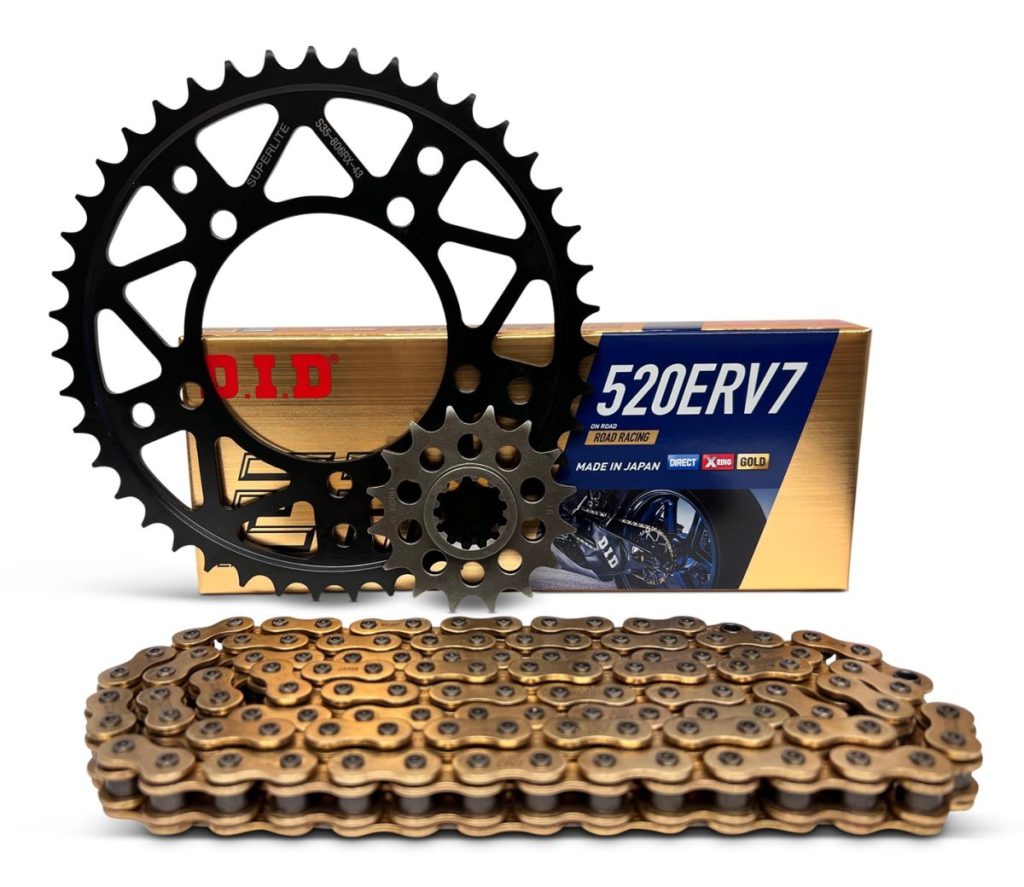
Precision engineering defines the synergy between Superlite tooth geometry and D.I.D X-Ring technology. Drive Systems USA designs these sprockets with specific tolerances that complement the side-plate thickness and roller diameters of D.I.D chains. This exact fitment reduces lateral movement and vibration, which preserves the integrity of the X-Ring seals. By maintaining the lubricant inside the rollers and keeping contaminants out, the system achieves a lower coefficient of friction and higher mechanical efficiency during high-torque applications.
Choosing the Right Chain for Your Superlite Sprockets
The D.I.D ZVM-X series is the definitive choice for high-displacement street bikes, offering a tensile strength of 10,408 lbs for the 525 pitch variant. It’s designed to handle the massive torque loads of 1000cc+ engines without excessive elongation. For competitive racing or track-day enthusiasts, the D.I.D ERV7 provides a lighter alternative with a tensile strength of 8,800 lbs. This reduction in rotating mass improves throttle response, though it requires more frequent inspection intervals than the ZVM-X. Always prioritize a rivet-style master link for any machine producing over 50 horsepower; clip-style links are generally reserved for smaller displacements or off-road environments where quick changes are necessary.
Why Order Direct from Drive Systems USA? Experience!
Drive Systems USA functions as the primary designer of Superlite products, meaning their technical support staff possesses the specific blueprints and fitment data for over 1,500 motorcycle models. They verify that every kit includes the correct spacer requirements and offset specifications to maintain a perfect chain line. As an authorized distributor for D.I.D. products, they guarantee that every chain is authentic and sourced directly from the manufacturer. You can build your custom Superlite sprocket and chain kit today to ensure your drivetrain meets these rigorous industrial standards.
Before finalizing your drivetrain upgrade, use this technical checklist to confirm your specifications:
-
Pitch Verification: Confirm if you’re staying with the OEM pitch (usually 525 or 530) or performing a 520 conversion for weight savings.
-
Gearing Ratio: Determine if you need a +1 or +2 tooth increase on the rear for better acceleration, or a -1 on the front.
-
Tensile Strength: Match the chain’s rated strength to your motorcycle’s peak torque output.
-
Master Link Tooling: Ensure you have a high-quality chain press and riveting tool to properly flare the pin heads to the manufacturer’s specified diameter.
-
Alignment Check: Use a laser alignment tool to verify the Superlite sprockets are perfectly parallel, preventing uneven side-plate wear.
Selecting a matched kit eliminates the guesswork of component compatibility. It’s the most efficient way to ensure your power transmission system operates at peak performance for thousands of miles. By investing in a complete system, you’re protecting your transmission output shaft and rear hub from the harmonic vibrations caused by mismatched or worn-out drivetrain parts.
Precision Engineering for the Modern Rider
Upgrade your drivetrain with authentic Superlite Sprockets
Frequently Asked Questions
How long do Superlite steel sprockets typically last?
Superlite steel sprockets typically provide a service life of 15,000 to 20,000 miles when paired with a high quality sealed chain and maintained properly. These components are manufactured from C45 high carbon steel or chromoly, undergoing induction hardening to reach a 50 HRC surface hardness. This metallurgical process ensures the teeth resist deformation under high torque loads. Regular lubrication every 500 miles and maintaining proper chain tension are critical factors in achieving these longevity figures.
Can I use an aluminum Superlite sprocket on a 1000cc street bike?
You can use an aluminum Superlite sprocket on a 1000cc street bike, but it’s primarily engineered for track applications where weight reduction is prioritized over durability. For high horsepower machines producing over 170 rear wheel horsepower, a 7075-T6 aluminum sprocket will typically wear out within 8,000 to 10,000 miles. Most street riders should opt for the RSX steel series to maintain mechanical integrity during long distance commutes and aggressive street riding.
What is the difference between Superlite RSX and RSX-R sprockets?
The primary difference lies in material composition and weight, as the RSX is a lighteight steel sprocket while the RSX-R utilizes aircraft grade alloy that’s been hard anodized for added durability.
Do I need to change my chain when I install new Superlite sprockets?
You should always install a new chain when replacing your Superlite sprockets to prevent premature wear on the new components. A used chain has elongated pins and bushings, which creates a pitch mismatch that can erode new sprocket teeth in less than 500 miles. Installing a complete 520 or 525 drive kit ensures that the chain rollers seat perfectly within the tooth valleys. This synchronization optimizes power transfer and extends the operational life of the entire drivetrain by up to 50%. To master the precise installation steps and alignment standards required for a professional-grade result, review our detailed motorcycle chain replacement guide covering tensile strength and pitch accuracy.
How much weight can I save with a Superlite 520 conversion kit?
A Superlite 520 conversion kit typically reduces unsprung weight by 1.5 to 3.5 pounds depending on the original OEM equipment. On a standard 1000cc motorcycle, switching from a 530 steel setup to a 520 RSX steel rear sprocket and a drilled front sprocket removes substantial rotating mass. This reduction improves throttle response and lessens the gyroscopic effect during high speed cornering. It’s an engineered solution that provides a measurable performance gain for riders seeking better flickability. For a deeper technical understanding of how moto sprocket pitch selection and rotating mass reduction affect real-world acceleration, our engineering guide provides the precise calculations behind these performance gains.
Are Superlite sprockets made in the USA?
Superlite sprockets are engineered and designed in the United States, with final quality control and distribution handled by Drive Systems USA in Arizona. The brand sources premium materials, including European chromoly and aerospace grade 7075-T6 aluminum, to meet strict ISO 9001 manufacturing standards. Every batch undergoes rigorous testing to ensure tolerances remain within 0.002 inches of the design specification. This commitment to precision ensures that every component meets the demands of professional racing and industrial applications.
This global operation, from sourcing materials to supporting international race teams, relies on precise communication. For companies facing similar multilingual challenges in the manufacturing or racing industries, click here to find professional language services.
How do I know if my current sprockets are worn and need replacement?
You can identify worn sprockets by looking for a hooked appearance on the teeth or a visible reduction in tooth thickness. If the teeth appear pointed or if you can pull the chain away from the rear of the sprocket by more than 3 millimeters, the components have reached their service limit. Replacing Superlite sprockets before they reach this stage prevents chain failure. Worn sprockets increase friction, which can lead to a 5% loss in power delivery to the rear wheel.
What gearing ratio should I choose for better acceleration?
To achieve faster acceleration, you should decrease the tooth count on the front sprocket or increase the tooth count on the rear. Dropping 1 tooth on the front is roughly equivalent to adding 2.75 to 3 teeth on the rear. This modification increases torque at the rear wheel but will reduce the motorcycle’s theoretical top speed. For most street applications, adding 2 teeth to the rear sprocket provides a noticeable 7% increase in low end pull without requiring a significantly longer chain.